
Body Mass Index (BMI) is a critical measure used by healthcare professionals worldwide to assess an individual’s overall health. Accurate BMI measurements can help detect potential health risks, guide treatment decisions, and monitor the success of weight management strategies. In hospital settings, the need for precise and reliable BMI scales is essential to ensure patient safety and effective health management.
Selecting the right BMI scale for hospitals is not a simple task, as several factors must be considered, including accuracy, capacity, and ease of use. Hospitals in South Africa, like those elsewhere, require scales that are durable, accurate, and compliant with health regulations to deliver consistent, high-quality care.
What is a BMI Scale?
A BMI scale is a specialized type of weighing scale designed to calculate a person’s Body Mass Index (BMI) based on their weight and height. Unlike traditional scales that only measure weight, BMI scales factor in height to provide a broader indication of a person’s health. These scales are widely used in hospitals, clinics, and healthcare settings to monitor patients, guide treatment plans, and identify individuals at risk for diseases related to obesity or malnutrition.
BMI is a critical metric used by doctors, nutritionists, and fitness experts to assess whether a person’s weight is within a healthy range. BMI scores help identify underweight, normal weight, overweight, and obese categories, which can help guide healthcare professionals in diagnosing and managing related health risks, such as diabetes, heart disease, and hypertension.
BMI Defined
Body Mass Index (BMI) is a simple formula calculated using a person’s weight (in kilograms) divided by the square of their height (in meters). The formula is:
BMI = weight (kg) ÷ height (m²)
While BMI isn’t a perfect indicator of health, it’s widely used in medical practice as a general tool for weight classification. Healthcare providers use BMI to gauge the risk of disease, but it should be considered along with other factors like age, gender, muscle mass, and overall fitness.
BMI Scales vs Regular Weighing Scales
Unlike regular weighing scales, which only measure a person’s weight, BMI scales include built-in features to calculate BMI automatically once the height and weight are entered. These scales often come with a digital display that shows both the weight and BMI reading in an easy-to-read format.
- Regular Weighing Scales: Only show weight measurements.
- BMI Scales: Calculate BMI, often showing a full readout of weight, BMI, and sometimes other health metrics such as body fat percentage or body water percentage.
Importance of Accuracy in BMI Measurement
In hospital environments, accuracy is paramount. Incorrect BMI readings can lead to improper diagnoses, ineffective treatment plans, and the risk of overlooking potential health problems. A highly accurate BMI scale helps healthcare providers assess patient health effectively and make informed decisions regarding treatment, dietary changes, or further medical testing. The principles of industries that weighing accuracy improves business efficiency apply equally to hospitals, where precise data reduces the risk of costly misdiagnoses and treatment delays.
Key Features to Consider When Choosing a BMI Scale for Hospitals
When selecting the best BMI scale for hospitals, it’s important to evaluate several key features that will determine its performance and usefulness in your facility. Let’s break down these essential factors:
1. Accuracy and Precision
For hospitals, the accuracy of BMI scales is crucial. A small measurement error can lead to inaccurate BMI readings, which could affect diagnosis and treatment decisions. Look for scales that offer high-precision sensors and regular scale calibration to ensure consistent results.
2. Weight Capacity and Range
Different hospital departments require scales that can accommodate a wide range of patient sizes. For instance, obesity care requires scales with a higher weight capacity. The ideal BMI scale should support a variety of weight limits to accommodate all patient types.
3. Ease of Use
Hospital staff should be able to use the BMI scale without difficulty. Scales with simple interfaces, large digital displays, and clear BMI readouts are essential for efficient operation in a busy healthcare environment. Look for models that allow for quick height input and automatic BMI calculations to save time.
4. Durability and Build Quality
Hospitals require sturdy and long-lasting equipment. The BMI scale should be able to withstand continuous use in busy hospital settings. Consider scales made from high-quality materials such as stainless steel for durability and easy maintenance.
5. Wireless and Connectivity Features
Many modern BMI scales come with wireless capabilities that allow data to be transmitted directly to a hospital’s patient management system or Electronic Health Records (EHR). This integration can significantly improve the efficiency and accuracy of patient records.
6. Compliance and Certification
It’s essential to choose scales that meet local health and safety regulations. In South Africa, BMI scales used in hospitals should be calibrated by SANAS-accredited laboratories and meet applicable medical device and measurement standards. Certification ensures that your scale meets the required health regulations. In South Africa, healthcare facilities must adhere to strict medical scale standards and requirements to ensure that patient data is legally defensible and clinically accurate.
Top BMI Scales for Hospitals in South Africa
After considering the critical features of a BMI scale, let’s explore the best BMI scales for hospitals in South Africa. These scales are selected based on their accuracy, durability, ease of use, and advanced features that make them ideal for hospital environments.
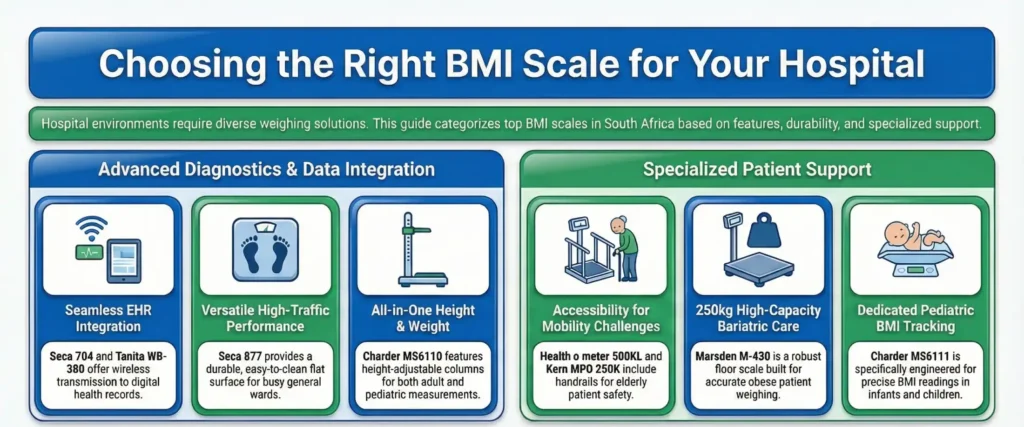
1. Seca 877 Digital Flat Scale
The Seca 877 is a leading choice for hospitals looking for a simple yet reliable BMI scale. Designed with an easy-to-clean flat surface, it ensures hygienic use in high-traffic hospital environments. This scale features a high capacity and a large digital display, making it easy for healthcare professionals to read and record patient data. Its memory function allows for seamless data storage, ensuring patient records are easily accessible for follow-up visits.
Key Features:
- High capacity (up to 300 kg)
- Large digital display for clear readability
- Memory function to store patient data
Accuracy Class: Class III medical scale
Certification: CE certified for medical use
The Seca 877 is ideal for hospitals as it is durable, space-saving, and provides accurate readings consistently. Its simplicity and high functionality make it perfect for general weight and BMI tracking in hospital settings.
2. Tanita WB-380 Digital Medical Scale
The Tanita WB-380 is a versatile digital scale that offers comprehensive body fat and BMI measurements. Its built-in automatic BMI function makes it an excellent choice for hospitals aiming to provide detailed health assessments. Additionally, the scale’s wireless connectivity allows for seamless integration with hospital data systems, providing a more efficient patient tracking experience.
Key Features:
- Wireless connectivity for easy integration with hospital data systems
- Comprehensive health management features, including body fat measurement
- High accuracy in BMI and body composition measurements
Accuracy Class: Class III medical scale
Certification: CE, FDA-approved for medical use
The Tanita WB-380 is particularly beneficial for hospitals focusing on comprehensive health assessments, allowing for a detailed view of patient health metrics, making it a go-to choice for facilities that prioritize health management.
3. Charder MS6110 Column Scale
The Charder MS6110 is a column scale designed for both adult and pediatric use. This scale integrates BMI measurements and features an adjustable column, making it versatile and suitable for a wide range of patients. Its large digital display ensures easy readability, while the height-adjustable column makes it ideal for hospitals with diverse patient needs.
Key Features:
- Integrated BMI measurement
- Easy height adjustment for flexibility
- Large, easy-to-read digital display
Accuracy Class: Class III medical scale
Certification: CE certified for medical use
The Charder MS6110 is ideal for hospitals that require flexibility in scale usage, particularly those with a mix of adult and pediatric patients. Its adaptability and ease of use make it an essential tool for hospital environments.
4. Health o meter 500KL Digital Medical Scale
The Health o meter 500KL is specifically designed to accommodate patients with mobility challenges, making it a valuable addition to any hospital. It features built-in BMI functionality, handrails for additional support, and a non-slip surface to ensure patient safety. The large, easy-to-read digital display allows for accurate readings, even for those with mobility issues.
Key Features:
- Handrails for additional patient support
- Non-slip surface for safety
- Large, easy-to-read display for clear measurements
Accuracy Class: Class III medical scale
Certification: CE, FDA certified for medical use
Perfect for hospitals serving patients with mobility challenges, the Health o meter 500KL ensures both safety and accuracy, making it a reliable choice for a wide range of healthcare environments.
5. Marsden M-430 High-Capacity Floor Scale
The Marsden M-430 is a high-capacity floor scale designed for heavier patients, offering reliable BMI and weight measurements. It is ideal for hospitals that need to support obese patients or individuals requiring higher weight capacities. The anti-slip surface ensures safety during use, and its high precision ensures accurate measurements, even in demanding environments.
Key Features:
- High capacity (up to 250 kg)
- Anti-slip surface for enhanced patient safety
- High precision for accurate readings
Accuracy Class: Class III medical scale
Certification: CE certified for medical use
The Marsden M-430 is built for durability and precision, making it a great fit for hospitals that need to weigh patients with higher body weights accurately and safely.
6. Seca 704 Column Scale with BMI & Wireless Transmission
The Seca 704 is equipped with advanced features such as BMI measurement and wireless data transmission. This scale can seamlessly integrate with electronic health records (EHR) systems, making patient data management more efficient. With its memory functions, it stores patient data for easy retrieval, ensuring a smoother patient experience.
Key Features:
- Wireless data transmission for integration with EHR
- Memory functions to store patient data
- Automatic BMI calculation for ease of use
Accuracy Class: Class III medical scale
Certification: CE, FDA-approved for medical use
The Seca 704 is perfect for hospitals looking to integrate BMI scales into their electronic health management systems. Its seamless integration with hospital data systems enhances operational efficiency.
7. Kern MPD 250K Scale with Handrails
The Kern MPD 250K is designed with handrails to assist patients during the weighing process. Its electronic weighing system and integrated BMI function make it ideal for use in hospital environments, especially for elderly or mobility-impaired patients. The easy-to-read digital display and robust build make it a reliable scale for regular use.
Key Features:
- Electronic weighing system for accurate readings
- Easy-to-read digital display
- Integrated BMI function for accurate assessments
Accuracy Class: Class III medical scale
Certification: CE certified for medical use
The Kern MPD 250K is a solid choice for hospitals that care for elderly or mobility-impaired patients, providing support and comfort while delivering accurate BMI measurements.
8. Charder MS6111 Pediatric Baby Scale
The Charder MS6111 is a pediatric scale designed for precise BMI readings in infants and young children. Its portable design makes it ideal for pediatric clinics or hospital pediatric wards. The large digital display is easy to read, ensuring accurate BMI and weight measurements for pediatric patients.
Key Features:
- Portable design for easy use in different settings
- Integrated BMI function for children
- Easy-to-read digital display for precise measurements
Accuracy Class: Class III medical scale
Certification: CE certified for medical use
The Charder MS6111 is an essential tool for pediatric clinics or hospitals with pediatric departments, providing reliable BMI readings for babies and young children.
Common Questions About BMI Scales for Hospitals in South Africa
1. What is the best BMI scale for a hospital with a high patient volume?
For hospitals with high patient volumes, the Seca 704 Column Scale and Tanita WB-380 are ideal due to their high accuracy, durability, and capacity for frequent use.
2. How do I choose the right BMI scale for elderly patients?
For elderly patients, look for scales with handrails and easy-to-read displays, such as the Health o meter 500KL or Kern MPD 250K, which ensure safety and comfort.
3. How often should a BMI scale be calibrated in a hospital?
BMI scales should be calibrated annually, but high-volume hospitals may require quarterly calibration to maintain consistent accuracy and regulatory compliance.
4. Are BMI scales covered by medical equipment insurance in South Africa?
Yes, many medical equipment insurance policies cover BMI scales, but it’s important to confirm the specific terms with your insurance provider.
5. How can I integrate BMI scales with hospital data systems?
Look for scales with wireless capabilities, like the Seca 704 Column Scale, which can easily integrate with hospital management systems via Wi-Fi or Bluetooth.
Final Thought
Choosing the right BMI scale for your hospital ensures that patients receive accurate measurements and helps healthcare professionals make informed decisions about patient care. Whether you need a compact digital scale or a high-capacity model, the scales listed in this guide provide top-notch performance and ease of use.
At Scales4U, we specialise in providing high-quality, medical-grade BMI scales for hospitals in South Africa. Whether you’re upgrading your hospital’s weighing systems or starting fresh, our team can guide you through selecting the right scale for your needs. Contact us for a free consultation and discover the best BMI scale solutions for your facility.