
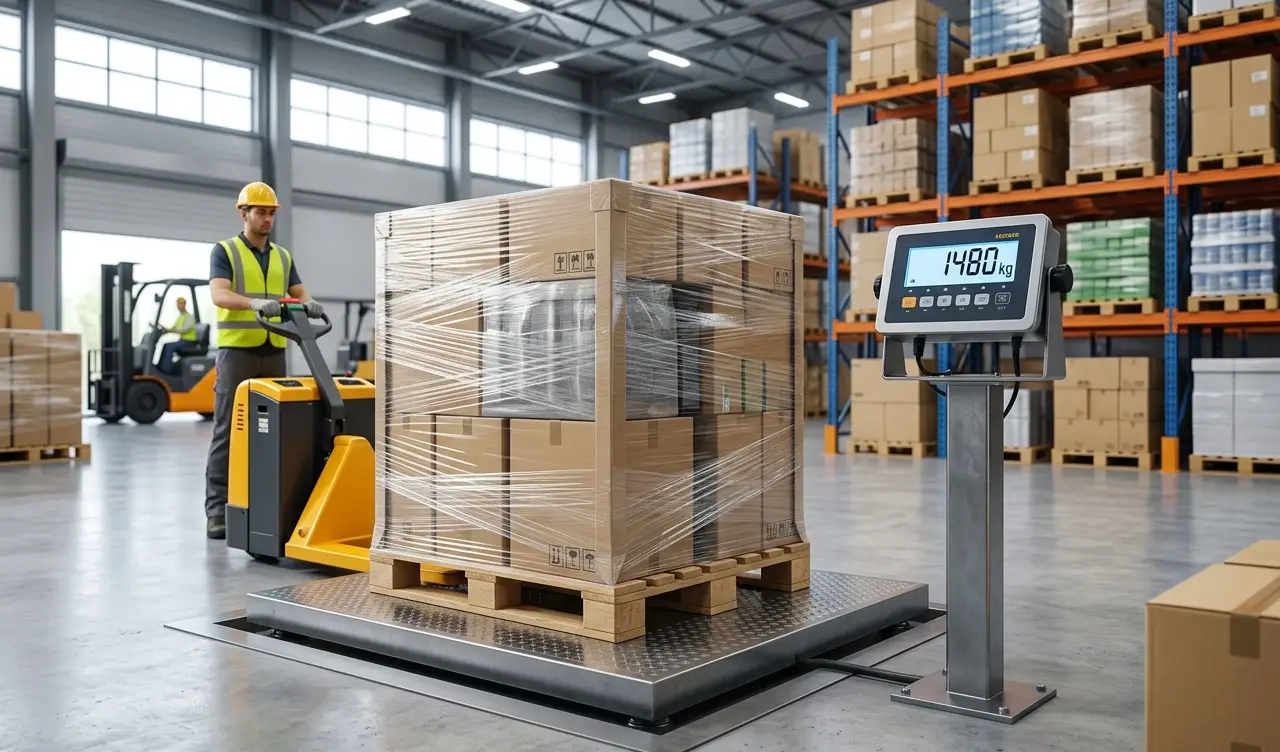
Warehouses, logistics centers, and manufacturing facilities across South Africa handle thousands of pallets daily, each carrying goods that require accurate weight measurement. Mismanaged pallet weights can result in inventory discrepancies, shipping errors, safety risks, and compliance issues. This is where a pallet weighing scale becomes essential. Designed to measure palletized goods efficiently and safely, these scales integrate advanced load cells, strain gauge technology, and digital indicators to deliver precise weight readings.
Whether for heavy load weighing in manufacturing, inventory management in warehouses, or high-capacity agricultural and chemical applications, pallet scales optimize workflow, reduce human error, and enhance operational safety. At Scales4U, we supply, calibrate, and maintain a wide range of industrial pallet weighing systems, ensuring accurate and reliable measurements for South African businesses.
What is a Pallet Weighing Scale?
A pallet weighing scale, also known as a pallet truck scale, pallet jack scale, or pallet platform scale, is a specialized weighing device designed to measure the weight of pallets and palletized loads. Unlike conventional floor scales, pallet scales are engineered for mobility, high capacity, and integration with warehouse operations. They can weigh flat pallets, palletized boxes, containers, and heavy objects quickly while maintaining accuracy, safety, and compliance with trade-approved standards.
Most pallet scales use strain-gauge load cells, which convert the force from the pallet’s weight into an electrical signal. This signal is processed and displayed on a digital indicator, often including additional features like tare functions, unit conversion, and data logging. The weighing platform or forks are designed for durability, typically constructed from stainless steel to withstand heavy load weighing, moisture, and industrial wear. Portable designs may include handles and wheels, allowing warehouse staff to move the scale between locations, while stationary units integrate with forklifts or trucks for heavy-duty logistics applications.
By accurately measuring palletized goods, these scales play a key role in industrial weighing systems, warehouse operations, logistics and distribution, manufacturing processes, and quality control, ensuring operational efficiency and regulatory compliance.
Key Benefits of Pallet Weighing Scales
Pallet weighing scales provide numerous advantages for industrial and commercial operations:
- Accurate Weight Measurement: Ensures high-capacity weighing of pallets from 1,000 kg to 3,000 kg with minimal error, thanks to strain gauge load cells and precise digital indicators.
- Efficient Warehouse Operations: Allows staff to weigh pallets during loading, unloading, and storage, improving workflow efficiency and reducing manual handling errors.
- Enhanced Safety and Ergonomics: Many scales include handles, wheels, and low-profile designs, enabling safe operation and reducing strain during pallet movement.
- Data Logging and Connectivity: Advanced models feature USB, Wi-Fi, and Bluetooth connectivity, enabling integration with inventory management systems and digital record-keeping.
- Versatility Across Industries: From food and beverage palletized products to chemical, pharmaceutical, agricultural, and manufacturing applications, pallet scales are adaptable to diverse operational needs.
- Compliance with Standards: Most pallet scales meet legal-for-trade standards and provide reliable readings for inventory management, quality control, and commercial transactions.
Scales4U offers a wide range of pallet weighing scales, including U-frame pallet scales, platform pallet scales, low-profile scales, specialty/custom designs, and pallet beam scales, each designed for specific industrial applications. Our team also provides professional installation, calibration, and maintenance services, ensuring South African businesses achieve maximum accuracy and efficiency in palletized goods weighing.
Components of a Pallet Weighing Scale
A pallet weighing scale is more than just a platform for placing pallets—it’s a precision industrial tool designed for accurate force measurement and efficient warehouse operations. Understanding its components is essential for selecting the right scale and ensuring proper usage.
Weighing Platform
The weighing platform is the surface on which pallets are placed. Depending on the scale type, the platform may be flat, low-profile, or U-frame to accommodate various pallet designs. Platforms are typically made from stainless steel or heavy-duty steel, offering durability for high-capacity weighing (1,000 kg – 3,000 kg) and resistance to wear, moisture, and chemicals. Some platforms include fork-style beams for integration with pallet jacks or forklifts, ensuring safe and ergonomic handling of palletized goods.
Load Cells / Strain Gauge Load Cells
At the heart of any pallet scale are the load cells, which measure the force exerted by the pallet and its contents. Most pallet scales use strain gauge load cells, which detect elastic deformation when a load is applied and convert it into an electrical signal.
Different types of load cells are used depending on the scale design:
- S-beam / S-type load cells – suitable for pallet trucks and mobile scales, measuring both tension and compression.
- Shear beam and bending beam load cells – common in platform scales for warehouses and industrial use.
- Column or multi-column load cells – designed for high-capacity pallet weighing in heavy-duty applications.
- Miniature or button load cells – compact applications where space is limited.
Load cells ensure high accuracy, repeatability, and compliance with calibration standards such as OIML C6, ISO 376, or ASTM E74, making them suitable for legal-for-trade industrial operations.
Display Unit / Digital Indicators
The digital display provides a clear, real-time readout of pallet weight. Modern displays often include:
- Tare function – subtracts the pallet weight to measure only the load
- Unit conversion – switch between kilograms, pounds, or tons
- Data logging – record and transfer weights via USB, Wi-Fi, or Bluetooth
- Trade-approved certification – ensuring compliance for commercial transactions
Displays can be mounted on a column, integrated into the scale, or portable for mobile operations, providing flexibility across warehouse and industrial workflows.
Handles and Wheels
Many pallet weighing scales are portable, equipped with ergonomic handles and heavy-duty wheels. This allows staff to move scales between locations safely, improving workflow efficiency in warehouses, manufacturing floors, and distribution centers. Handles also enhance ergonomic safety, reducing the risk of injury during manual movement.
Power Source (Batteries or Mains)
Pallet scales can be powered by rechargeable batteries or mains electricity, depending on the application:
- Battery-powered scales – ideal for mobile use in warehouses, retail, or farms.
- Mains-powered scales – suitable for stationary industrial setups, high-frequency use, or continuous operations.
Some models combine both options, allowing uninterrupted operation during power outages or while moving the scale.
Connective Ports (USB, Wi-Fi, Bluetooth)
Advanced pallet scales feature connectivity options for data logging, warehouse management, and integration with ERP systems. These ports allow real-time weight tracking, reporting, and quality control, which is particularly useful in food and beverage, chemical, and pharmaceutical industries where accurate documentation is essential.
How a Pallet Weighing Scale Works (Working Principle)
A pallet weighing scale measures the weight of palletized goods by converting the force exerted on the weighing platform into an electrical signal via load cells. Here’s a step-by-step overview of how a typical scale operates:
- Placement of the Pallet: The pallet is positioned on the weighing platform, which may include fork-style beams or flat surfaces, depending on the scale type. Proper placement ensures centered loading and prevents off-axis measurement errors.
- Force Transfer to Load Cells: The weight of the pallet and its contents applies force to the load cells embedded in the platform. Depending on the scale design, this may involve:
- Compression in column or platform scales
- Shear in shear beam or bending beam load cells
- Tension and compression in S-beam or truck-mounted scales
- Strain Measurement: Strain gauge load cells detect elastic deformation in the sensor material. These minute changes in shape result in electrical resistance variations, which are proportional to the applied force.
- Signal Conversion: The resistance changes are processed through a Wheatstone bridge circuit and amplified by the digital signal processor or microcontroller, producing a measurable output in kilograms, pounds, or tons.
- Display and Data Logging: The processed signal is displayed on the digital indicator, which may include tare functions, unit conversion, and connectivity for logging or integration into warehouse management systems.
- Safety and Accuracy Features: Modern pallet scales incorporate features like full-scale accuracy verification, zero return correction, off-axis load compensation, and overload protection, ensuring reliable measurements for industrial, commercial, and agricultural applications.
By combining precision load cells, durable platforms, digital indicators, and ergonomic handling features, pallet scales allow efficient, safe, and accurate measurement of palletized goods, whether in warehouses, distribution centers, farms, or manufacturing facilities.
Types of Pallet Weighing Scales
Pallet weighing scales come in a variety of designs, each tailored to different industrial, commercial, or agricultural applications. Selecting the right type ensures accurate measurement, operational efficiency, and safety.
U-Frame Pallet Scales
U-frame pallet scales feature U-shaped forks that allow for easy placement of standard pallets. These scales are ideal for low-profile applications where pallets need to be weighed without lifting. They commonly use strain gauge load cells and are portable, making them suitable for warehouses, logistics centers, and retail distribution.
Advantages:
- Compact and portable
- Compatible with standard pallet jacks
- Easy integration with digital indicators and data logging
Applications: Warehouses, small-scale manufacturing, retail distribution, South African logistics centers.
Platform Pallet Scales
Platform pallet scales have a flat, durable surface and are designed for heavier or irregularly shaped pallets. They often use shear beam or multi-column load cells to provide high-capacity, accurate measurements.
Advantages:
- Handles heavy loads from 1,000 kg to 3,000 kg
- Ideal for industrial and commercial warehouses
- Supports forklift-assisted loading and off-center pallets
Applications: Manufacturing plants, industrial warehouses, truck loading, and storage facilities.
Pallet Truck / Pallet Jack Scales
These scales combine a manual or electric pallet truck with a weighing system, allowing operators to move and weigh pallets simultaneously. They usually incorporate S-beam load cells for tension and compression measurement.
Advantages:
- Saves time during transport and weighing
- Reduces handling errors
- Portable for multi-location warehouse operations
Applications: Retail distribution, wholesale warehouses, small industrial facilities.
Forklift-Integrated Pallet Scales
These scales are integrated into forklift forks, allowing for the weighing of pallets during lifting and transport. They are equipped with multi-column or high-capacity S-beam load cells.
Advantages:
- Ideal for high-capacity operations
- Weighs pallets without additional handling
- Integrates with warehouse inventory systems
Applications: Large warehouses, distribution hubs, and heavy industrial operations.
Low-Profile & Specialty Pallet Scales
Low-profile scales allow weighing pallets where vertical clearance is limited, while specialty/custom scales cater to specific industrial requirements such as chemical, pharmaceutical, or food and beverage applications.
Advantages:
- Ergonomic design for safe handling
- Can include stainless steel construction for hygienic environments
- Options for digital connectivity, tare functions, and data logging
Applications: Food processing plants, chemical warehouses, pharmaceutical storage, and agricultural facilities.
Pallet Beam Scales
Pallet beam scales are lightweight, portable scales with adjustable beams and lever mechanisms. They are designed for irregular loads and smaller warehouses.
Advantages:
- Portable and flexible
- Accurate for small to medium loads
- Simple to use with digital indicators
Applications: Small warehouses, retail storage, and lightweight material handling.
Applications of Pallet Weighing Scales
Pallet scales are essential in many industries for the accurate measurement of palletized goods:
- Manufacturing: Material input/output, inventory control, quality assurance
- Warehousing & Logistics: Stock verification, shipment weighing, truck loading
- Retail & Wholesale: Weighing palletized products for shipping or storage
- Agriculture: Measuring fertilizers, animal feed, crops, and livestock
- Food & Beverage: Weighing packaged products with hygienic stainless steel scales
- Chemicals & Pharmaceuticals: Safe weighing of sensitive or hazardous materials
These applications benefit from strain gauge load cells, digital indicators, tare and unit conversion functions, and connectivity for data logging.
Selecting the Right Pallet Weighing Scale
Choosing the appropriate scale depends on load type, pallet size, environment, and operational requirements:
- Load Capacity: Ensure the scale can handle the maximum expected weight
- Scale Type: Portable (pallet truck scale) vs stationary (platform or forklift-integrated)
- Load Cell Types: S-beam, shear beam, bending beam, multi-column, or strain gauge depending on accuracy and load type
- Environmental Factors: Moisture, chemicals, hygiene standards, and IP rating for durability
- Display and Connectivity: Digital indicators with USB, Bluetooth, or Wi-Fi for inventory integration
- Ergonomics & Safety: Handles, wheels, and low-profile designs to reduce workplace injuries
At Scales4U, our experts help South African businesses select the right pallet scale for their specific needs, ensuring accuracy, efficiency, and compliance with trade-approved standards.
Maintenance and Calibration
Regular maintenance and calibration are essential for consistent performance and safety:
- Inspect load cells, wiring, and weighing platforms for damage or wear
- Check digital indicators, connectivity ports, and battery/mains power sources
- Perform calibration to maintain accuracy, full-scale reading, and zero return
- Protect scales from off-axis loading, shocks, or moisture
Professional calibration ensures that industrial pallet weighing systems operate reliably across South African warehouses, logistics operations, manufacturing facilities, and agricultural sites.
Pallet Scale Comparison
| Pallet Scale Type | Load Cell Type | Best Use | Key Features | Limitations |
| U-Frame | Single-point / Bending Beam | Low-profile pallets | Portable, compatible with pallet jacks | Lower maximum capacity |
| Platform | Shear beam / Multi-column | Industrial warehouses | High-capacity, durable | Requires a forklift or a ramp |
| Pallet Truck / Jack | S-beam | Retail / wholesale | Mobile, portable | Lower load range |
| Forklift-Integrated | Multi-column / S-beam | Heavy logistics | High capacity, fast weighing | Higher cost |
| Low-profile / Specialty | Shear beam / Compression | Hygienic or limited space | Compact, safe | Limited versatility |
| Pallet Beam | Single-column / Shear-web | Portability, irregular loads | Flexible, lightweight | Lower maximum load |
Frequently Asked Questions (FAQs)
1. How does a pallet weighing scale work?
A pallet scale uses load cells to measure the force exerted by the palletized goods. The signal is processed and displayed digitally, often with tare, unit conversion, and data logging functions.
2. What types of pallet scales are available?
Common types include U-frame, platform, pallet truck/jack, forklift-integrated, low-profile, specialty, and pallet beam scales.
3. What industries use pallet weighing scales?
They are used in warehousing, logistics, manufacturing, agriculture, food and beverage, chemical, and pharmaceutical operations.
4. How do I select the right pallet scale?
Consider load capacity, scale type, load cell type, environment, and connectivity options. Professional guidance ensures accuracy, efficiency, and safety.
5. How often should pallet scales be calibrated?
Calibration is recommended after installation, relocation, repair, or overloading, and periodically based on usage to maintain accuracy and compliance.
Final Thought
Pallet weighing scales are critical for accurate, safe, and efficient handling of palletized goods in South African warehouses, manufacturing plants, and logistics operations. From U-frame and platform scales to forklift-integrated and low-profile models, each type serves specific industrial needs. Proper installation, load cell selection, calibration, and maintenance ensure reliable measurement for quality control, inventory management, and regulatory compliance. At Scales4U, we provide a comprehensive range of pallet scales, load cells, digital indicators, and professional calibration and maintenance services, helping businesses across South Africa optimize industrial weighing processes and achieve operational efficiency, accuracy, and safety.