
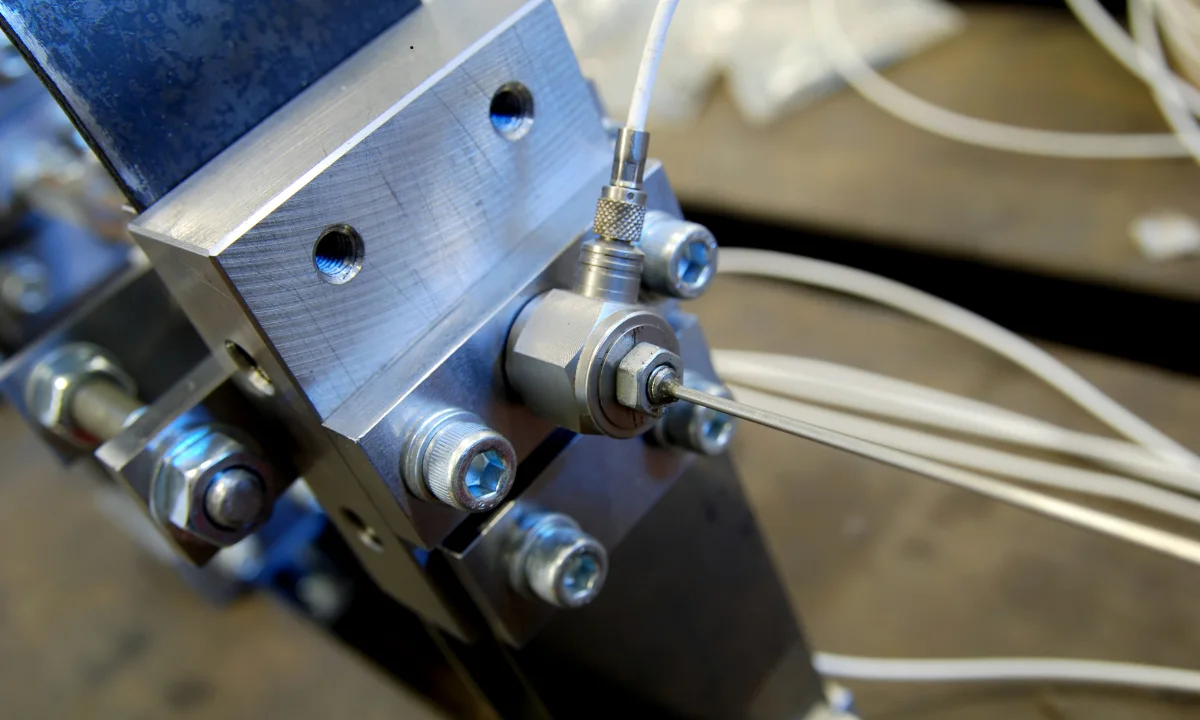
Weighing systems are the backbone of many industries in South Africa, from mining and agriculture to supermarkets and manufacturing. If your scales deliver inconsistent readings, frequent zero errors, or misaligned results, the problem often lies in the load cells, the force measurement sensors that convert physical weight into precise electrical signals. Choosing the right type of load cell is essential to maintain accuracy, prevent downtime, and ensure compliance with legal-for-trade standards. In this guide, we explain the types of load cells, their working principles, applications, and how to select the right one for your industrial, commercial, or laboratory weighing system. At Scales4U, we supply, install, calibrate, and maintain load cells for South African businesses, ensuring precision and reliability across every weighing application.
What Is a Load Cell and Why Does It Matter?
A load cell is a sensor used for force measurement. It is the critical component in most modern scales, from platform scales and bench scales to crane scales and industrial hoppers. By detecting elastic deformation under a load and converting it into an electrical signal, a load cell allows a weighing system to display accurate weight or force readings.
In simple terms, whenever you place a product on a supermarket scale, weigh materials in a factory, or measure payload in a mining operation, a load cell ensures that the weight is measured precisely and reliably. Load cells are designed for both static and dynamic loads, making them suitable for applications ranging from industrial hoppers, silos, and tanks to medical and postal scales.
Key benefits of using high-quality load cells include:
- High full-scale accuracy and repeatable readings
- Protection against off-axis loading and side forces
- Compliance with calibration standards such as ASTM E74, ISO 376, and OIML C6/C9
- Enhanced durability in harsh environments with stainless steel or aluminum bodies and IP-rated protection
- Integration into both simple scales and complex industrial automation systems
At Scales4U, we provide a wide range of strain gauges, S-beams, shear beams, bending beams, and button load cells, each designed to meet specific industrial requirements in South Africa. Our team also offers load cell calibration, verification, and maintenance, ensuring that your system performs accurately throughout its lifecycle.
How Does a Load Cell Work?
Understanding how a load cell functions is crucial when selecting the right sensor for your weighing application. Most modern load cells operate based on strain gauges, which measure elastic deformation caused by applied force. When weight is applied, the load cell deforms slightly, causing changes in electrical resistance. This change is then converted to a measurable voltage signal through a Wheatstone bridge circuit, which is interpreted by a digital indicator or control system.
Load cells can be designed to measure different types of forces:
- Compression forces – the load pushes downward on the sensor
- Tension forces – the load pulls on the sensor
- Shear forces – the load acts parallel to the sensor body
- Torque or bending forces – the load twists or bends the sensor
Key elements affecting load cell performance include:
- Rated load – the maximum safe force the load cell can measure
- Creep – small, gradual changes in output under a constant load
- Zero return – the sensor’s ability to return to zero after unloading
- Off-axis loading sensitivity – errors caused by force applied outside the main axis
- Hysteresis – difference in readings between increasing and decreasing loads
For example, a bending beam load cell deforms in a controlled way under weight, while a shear beam load cell uses shear-web spring elements to resist bending while providing precise force measurement. Miniature load cells and button load cells are designed for compact applications, whereas column load cells and multi-column load cells handle high-capacity industrial weighing tasks.
At Scales4U, all load cells are supplied with proper tapered bases, integral threaded rods, or top adapters, ensuring repeatable installation and alignment for maximum accuracy. We also provide professional calibration and verification, guaranteeing full-scale accuracy in commercial and industrial applications across South Africa.
Load Cell Technologies Explained
Understanding the different load cell technologies is crucial for selecting the right sensor for your weighing application. Each technology converts force measurement into an electrical signal in a unique way, and the choice depends on factors such as accuracy, environmental conditions, load type, and industrial application.
Strain Gauge Load Cells
Strain gauge load cells are the most widely used type of load cell in industrial, laboratory, and commercial weighing systems. They operate by measuring strain — the tiny deformation of the load cell body under force — using strain gauges bonded to the sensor. The strain changes the electrical resistance, which is converted into a measurable voltage signal through a Wheatstone bridge circuit.
These load cells are versatile and can be designed as bending beam load cells, shear beam load cells, single-column load cells, multi-column load cells, or S-beam / S-type load cells, making them suitable for platform scales, hopper scales, crane scales, and industrial automation systems.
Advantages:
- High full-scale accuracy and repeatability
- Wide range of capacities from miniature load cells to high-capacity industrial models
- Compatible with commercial and legal-for-trade scales
- Can handle axial and off-axis loading when properly installed
Limitations:
- Sensitive to environmental factors such as moisture and dust if not sealed
- Requires careful calibration and maintenance to maintain zero return and prevent creep
At Scales4U, we provide strain gauge load cells along with professional calibration, ensuring precision and reliability for South African businesses.
Hydraulic Load Cells
Hydraulic load cells operate using incompressible fluids. The applied force compresses the fluid inside the load cell, creating a pressure proportional to the load, which can then be read by a gauge or electronic sensor.
These load cells are ideal for heavy-duty weighing applications, including tank and silo scales, industrial platforms, and outdoor weighing systems. They are particularly useful in environments where electrical components may be exposed to moisture, dust, or explosive conditions.
Advantages:
- No electrical components at the sensing point, reducing risk in hazardous environments
- Durable and able to handle high-capacity loads
- Resistant to shock and vibration
Limitations:
- Less common in everyday commercial scales
- Requires regular maintenance to prevent fluid leaks
- Temperature variations can affect performance
Pneumatic Load Cells
Pneumatic load cells use air pressure to measure force. The applied load compresses an air-filled chamber, and the resulting pressure change is proportional to the force. These load cells are ideal for clean environments, such as food processing plants, chemical facilities, and laboratories, where spark-free operation is critical.
Advantages:
- Safe in hazardous or wet environments
- High sensitivity for precise measurement
- Non-electric at the sensing point, reducing risk of sparks
Limitations:
- Requires a stable, clean air supply
- Slower response compared to electronic load cells
- Less common in standard industrial weighing applications
Capacitive Load Cells
Capacitive load cells measure force based on changes in capacitance between conductive plates as the load deforms the cell. They are highly sensitive and suitable for precision industrial, laboratory, and R&D applications where minute force changes must be detected.
Advantages:
- Excellent for precision and low-capacity applications
- Compact and low-profile designs possible
- Can be sealed for hazardous or wet environments
Limitations:
- Not ideal for high-capacity industrial applications
- Sensitive to temperature and electrical interference
- Typically more expensive than strain gauge alternatives
Piezoelectric Load Cells
Piezoelectric load cells generate an electrical charge when subjected to dynamic forces, making them suitable for impact testing, vibration monitoring, and high-frequency industrial processes. They are not typically used for static weighing, but they excel in dynamic force measurement applications.
Advantages:
- Excellent response to fast-changing loads
- Ideal for industrial test machines and robotics
- Can handle shock and vibration
Limitations:
- Not suitable for static weighing applications
- Requires signal conditioning for accurate measurement
Load Cell Designs by Application
The physical design of a load cell directly affects how it handles force measurement, mounting, and environmental conditions. Choosing the right design ensures accuracy, repeatability, and long-term durability.
Single Point Load Cell
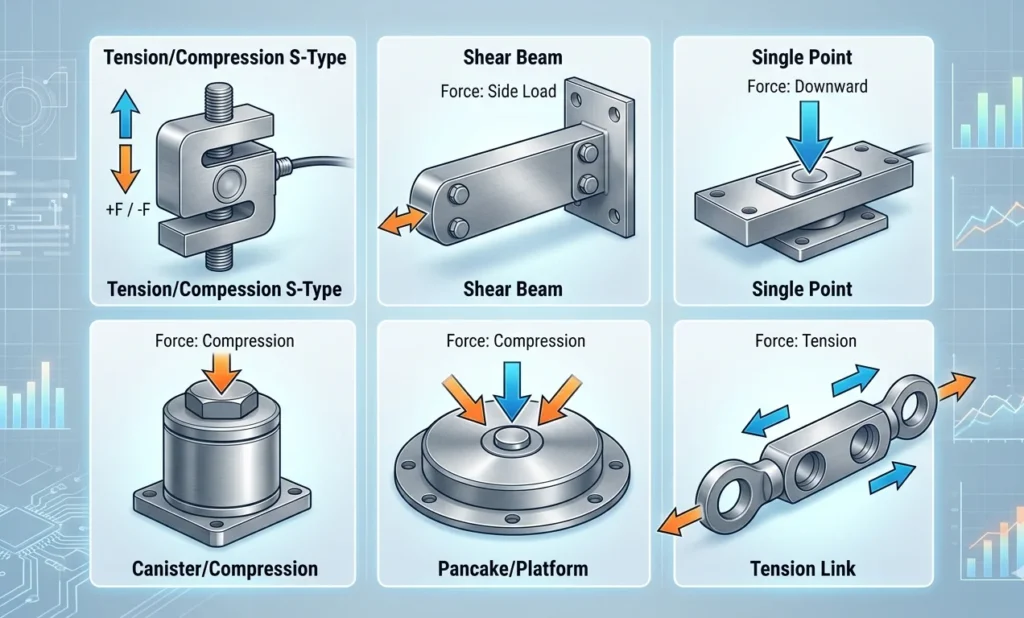
Single-point load cells are designed for small to medium platform scales where the load may not always be centered. They are commonly used in retail scales, bench scales, counting scales, and packaging scales. These load cells are ideal for accurate commercial applications where off-center loading is common.
Shear Beam Load Cell
Shear beam load cells measure force through shear strain. They are widely used in industrial floor scales, pallet scales, hopper scales, and medium-capacity platform scales. Shear beam designs, including shear web load cells, provide precision and robustness in demanding industrial environments.
Double-Ended Shear Beam Load Cell
Double-ended shear beam load cells are supported at both ends and are used for high-capacity platforms, weighbridges, silos, and truck scales. This design distributes force evenly, providing high precision and stability for heavy loads.
S-Beam / S-Type Load Cell
S-beam load cells have an “S” shaped body capable of measuring tension and compression forces. They are commonly used in crane scales, hanging loads, and inline force measurement applications. S-beam load cells are valued for their versatility and adaptability in both industrial and laboratory applications.
Compression Load Cell
Compression load cells measure downward forces, making them ideal for tank, silo, and platform weighing. They are also used in industrial presses and structural testing, where high capacity and durability are critical.
Button / Disc Load Cell
Button load cells and disc load cells are compact, low-profile sensors used for precision compression force measurement in test machines, press monitoring, and compact industrial applications.
Load Pin and Tension Link Load Cells
Load pin load cells replace standard pins in lifting systems to measure pivot forces, while tension link load cells measure pulling forces in hoists, cranes, and suspended loads. Both are essential for safety-critical force measurement in industrial applications.
Multi-Axis / Planar Load Cells
Multi-axis load cells measure forces in more than one direction, making them suitable for robotics, automation, research, and development. They are commonly integrated into high-precision industrial systems and laboratory equipment where multi-directional force measurement is required.
Load Cell Types Comparison Table
| Load Cell Type | Force Measured | Typical Use | Advantages | Limitations |
| Single Point | Compression | Retail, bench, small platforms | Off-axis load compensation, accurate | Low capacity |
| Shear Beam | Shear | Industrial floors, hoppers, pallet scales | Robust, precise | Requires proper mounting |
| Double-Ended Shear Beam | Shear | Truck scales, weighbridges | High-capacity, stable | Larger footprint |
| S-Beam / S-Type | Tension & Compression | Crane scales, hanging loads | Versatile, dual-force measurement | Sensitive to misalignment |
| Compression | Downward | Tanks, silos, heavy platforms | High capacity | Limited tension measurement |
| Button / Disc | Compression | Test machines, compact applications | Low profile, precise | Limited load |
| Load Pin / Tension Link | Tension / Pivot | Hoists, cranes, rigging | Safe for lifting | Higher cost, specialized |
| Multi-Axis | Multiple directions | Robotics, R&D | Multi-directional sensing | Expensive, complex |
How to Choose the Right Load Cell
Selecting the appropriate load cell is crucial to achieving accurate force measurement and reliable scale performance. The choice depends on multiple factors, including load type, capacity, environment, and weighing application.
Key considerations include:
- Type of Force
Determine whether the load is tension, compression, shear, or a combination. For example, S-beam load cells measure both tension and compression, while compression load cells are designed for downward forces. - Load Capacity
Select a load cell that accommodates your maximum expected load plus a safety margin. Exceeding the rated load can damage the sensor or reduce full-scale accuracy. - Scale Type and Application
- Platform scales: Single point or shear beam load cells
- Crane scales: S-type or tension link load cells
- Tank or silo weighing: Compression, shear beam, or canister load cells
- Retail and bench scales: Single point or planar beam load cells
- Environmental Conditions
Consider dust, moisture, temperature variations, and chemical exposure. Stainless steel load cells with IP65–IP68 protection are recommended for harsh environments in South African industrial sites. - Accuracy Requirements
For legal-for-trade scales, laboratory testing, or high-precision applications, ensure the load cell complies with calibration standards like ASTM E74, ISO 376, or OIML C6/C9. - Installation and Mounting
Proper installation prevents off-axis loading, misalignment, and cosine error. Use tapered bases, integral threaded rods, and adapters for repeatable and stable mounting. - Maintenance and Calibration
Regular maintenance is critical to prevent creep, hysteresis, and zero return issues. Load cells should be professionally calibrated after installation, relocation, or repair to maintain accuracy.
Common Load Cell Problems and Maintenance Tips
Even high-quality load cells can experience issues if misused, overloaded, or poorly maintained. Being aware of common problems can help prevent downtime and inaccurate measurements.
Frequent issues include:
- Inaccurate or drifting readings – Often caused by creep, temperature changes, or electrical interference
- Zero-point errors – May result from misalignment, mechanical obstruction, or signal issues
- Signal instability – Loose wiring, damaged junction boxes, or off-axis loading
- Physical damage – Overload, impact, or corrosion can permanently damage the sensor
- Hysteresis – Difference in readings during increasing vs decreasing loads
Maintenance Tips:
- Inspect cables and connectors regularly
- Ensure proper mounting and alignment
- Clean load cell surfaces and protect from moisture or dust
- Perform scheduled calibration based on usage and application
- Replace damaged or overloaded cells immediately
We provide load cell repair, maintenance, and calibration services to keep your weighing systems operating with full-scale accuracy and compliance with South African trade standards.
Load Cell Calibration and Verification
Calibration is essential to maintain accuracy, repeatability, and compliance in all weighing applications.
What Calibration Involves:
- Comparing the load cell output to a reference standard
- Applying known loads and recording the electrical signal output
- Adjusting scale electronics or software for accurate measurement
Key Points for South African Businesses:
- Use ASTM E74, ISO 376, and OIML-certified standards
- Calibrate after installation, relocation, or repair
- Regularly check for creep, zero return, and full-scale accuracy
Professional calibration ensures that industrial, laboratory, and commercial scales perform reliably, reducing errors in production, inventory, and safety-critical operations.
Best Load Cell Type by Application
Here’s a quick guide to match load cell type with application for maximum accuracy and reliability:
| Application | Recommended Load Cell Type |
| Bench or retail scales | Single-point / planar load cell |
| Industrial platform scales | Shear beam or single-point load cells |
| Cranes / hanging scales | S-type / tension link load cells |
| Hopper or tank weighing | Compression/shear beam/canister load cells |
| Truck scales/weighbridges | Double-ended shear beam/canister load cells |
| Test machines / compact compression | Button/disc load cells |
| Robotics/automation | Multi-axis load cells |
This table allows South African businesses to quickly select the appropriate load cell based on application and load type.
Frequently Asked Questions (FAQs)
1. What are the main types of load cells?
Load cells can be classified by working principle (strain gauge, hydraulic, pneumatic, capacitive, piezoelectric) and design (single-point, shear beam, S-type, compression, button, load pin, multi-axis).
2. Which load cell is most common for industrial scales?
Strain gauge load cells dominate industrial and commercial applications due to their accuracy, versatility, and wide range of capacities.
3. How often should load cells be calibrated?
Calibration should be performed after installation, repair, relocation, or overload. For continuous-use scales, periodic checks ensure full-scale accuracy and zero return.
4. What is the difference between shear beam and single-point load cells?
Single-point load cells handle small to medium platforms with off-center loading, while shear beam load cells are robust for industrial platforms, hoppers, and high-capacity applications.
5. Can damaged load cells be repaired?
Minor issues like wiring or connector faults can be repaired, but physical or overload damage often requires replacement to maintain accuracy.
Final Thought
Understanding the types of load cells is essential for South African businesses that rely on precise industrial, commercial, and laboratory weighing systems. The right choice depends on force type, capacity, accuracy requirements, and environment. From single-point and shear beam load cells for platform scales to S-type, load pin, and multi-axis load cells for industrial and robotic applications, each type serves a specific purpose. Proper installation, calibration, and maintenance are crucial to prevent issues like creep, zero return errors, and off-axis loading.
At Scales4U, we supply a wide range of load cells, provide expert advice on selection, perform calibration, and offer maintenance and repair services, ensuring that your weighing systems remain accurate, reliable, and compliant across all South African industries.