

Weighing scales are essential tools used in industries ranging from healthcare and retail to manufacturing and logistics. These devices are relied upon for precision, whether it’s for monitoring a patient’s weight or ensuring the accuracy of bulk materials during packaging. However, many businesses and individuals often overlook how environmental factors, specifically temperature and other environmental conditions, can significantly impact the accuracy of these scales.
We will address the critical role that temperature, humidity, vibrations, and other environmental elements play in affecting the accuracy of weighing systems. Whether you are a manufacturing plant in need of precise material measurements or a healthcare facility monitoring patient weight, understanding these influences will help you maintain accurate, reliable results every time.
How Temperature Affects Weighing Scale Accuracy
Temperature is one of the most significant environmental factors affecting the accuracy of weighing scales. As load cells (the sensors in digital scales that measure weight) are sensitive to temperature changes, fluctuations can lead to inaccurate readings. This happens because metal components and electronic parts expand or contract with temperature changes, altering the precision of the measurements.
For example, in cold conditions, metals used in the scale may contract, causing the scale to show a reading that is slightly less than the actual weight. Conversely, in hot environments, materials tend to expand, potentially leading to a reading that is higher than the actual weight. This effect can be particularly noticeable in digital weighing scales, which rely on the precise measurements of electronic circuits.
In industries like pharmaceuticals, where accuracy is paramount, even small temperature changes can result in large discrepancies in weighing results. Similarly, in retail environments, slight inaccuracies could lead to customer dissatisfaction and legal consequences. For these reasons, understanding how temperature influences scale accuracy is essential for maintaining reliability in all sectors.
Temperature-Induced Load Cell Drift
One of the primary components of most digital weighing scales is the load cell. These load cells are sensitive to temperature changes, and the readings can drift if the temperature fluctuates. This phenomenon is known as load cell drift, where the sensor’s calibration becomes unstable due to temperature variations.
When a load cell is exposed to extreme temperatures, whether too hot or too cold, the electrical resistance of the materials in the load cell changes. This can lead to inaccurate readings, often without the user being aware of the issue. In some cases, this drift can be so significant that the scale needs recalibration to restore its accuracy.
For example, in an industrial setting where large quantities of materials are being weighed, even small shifts in temperature can lead to inconsistencies in the weight readings, which can affect product consistency and cause discrepancies in inventory tracking. Regular calibration becomes essential in these environments to correct temperature-induced errors in the system.
Managing Temperature Challenges in Scale Accuracy
To mitigate the impact of temperature on weighing systems, it’s crucial to maintain a stable environment for your scales. One of the easiest solutions is to ensure that scales are placed in temperature-controlled environments. For industries where precision is key, installing temperature-controlled rooms or air conditioning can help maintain a consistent operating temperature for the scales, preventing drastic shifts that could compromise their performance.
External calibration can also be used to ensure that scales are adjusted based on the specific temperature at the time of use. By performing this regular calibration, businesses can reduce errors caused by fluctuating temperatures and keep the scales functioning optimally.
Additional Environmental Factors Affecting Weighing Scale Accuracy
The Influence of Humidity and Moisture on Scale Accuracy
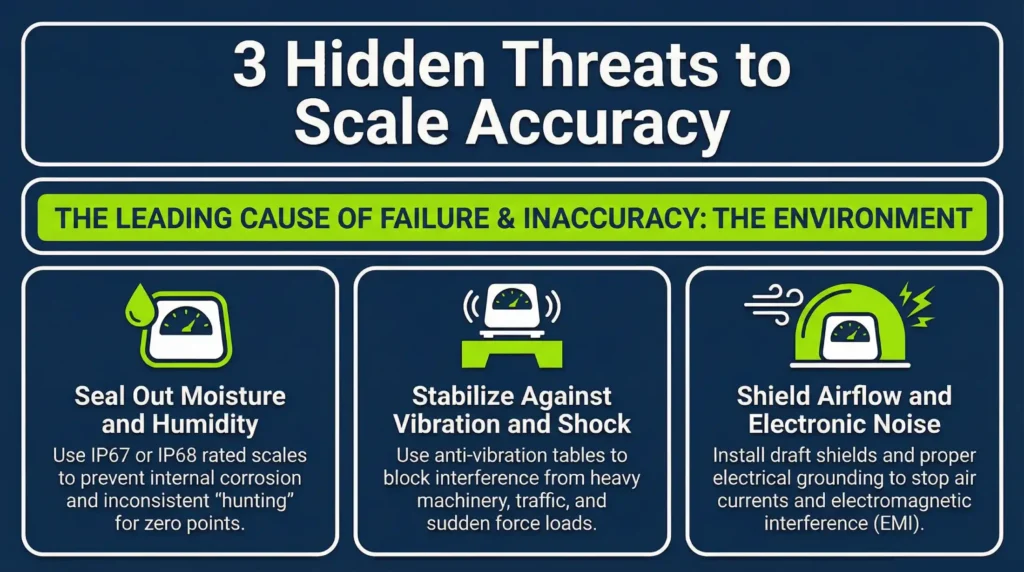
Humidity is another environmental factor that can negatively affect weighing scales. Moisture in the air can cause condensation on electronic components in digital scales, leading to malfunctions or inaccurate readings. Additionally, metal parts on mechanical scales can rust or corrode when exposed to moisture, leading to physical damage and compromising the scale’s performance. High humidity can cause microscopic condensation inside a junction box, which is a primary reason for scales giving inconsistent readings or ‘hunt’ for a stable zero point even when the platform is empty.
In industries such as pharmaceuticals, where precise measurement of ingredients is required, moisture could affect the balance of the measurements. Similarly, in agriculture, where grains, produce, and other commodities are weighed, moisture in the air can impact the scale’s accuracy.
The solution to humidity issues is to use weatherproof equipment designed to withstand high levels of moisture. Additionally, using dehumidifiers in environments with high humidity can help maintain the scales’ accuracy by reducing moisture build-up. Moisture-resistant scales are specifically built for such conditions, providing better reliability in humid environments.
Air Currents, Wind, and Their Impact on Precision
Air currents are another environmental factor that can interfere with weighing scales. Small movements in air, whether from an HVAC system or natural wind, can cause fluctuations in scale readings. This is particularly true for precision balances that are used to weigh small and delicate items, where even slight air disturbances can alter measurements.
To combat this issue, it’s important to place scales in areas with minimal air movement. Using draft shields or placing scales inside enclosed areas can help isolate them from environmental disruptions. Draft shields are often made of clear plastic or glass and can help shield the scale from airflow without obstructing the user’s view of the scale.
The Effects of Vibration and Shock on Weighing Systems
Another key factor that affects the accuracy of weighing scales is vibration. Vibrations from machinery, nearby traffic, or even the movement of people within the vicinity can cause instability in the weighing system. These vibrations can shift the scale slightly, leading to inaccurate readings.
In environments where vibration is common, such as manufacturing floors or industrial warehouses, anti-vibration tables and isolation pads can help. These tables or mounts are designed to absorb and dampen vibrations, ensuring that the weighing scales remain stable and accurate. This is particularly important for precision balances used in laboratories or scientific environments where minute changes in weight are crucial.
Electromagnetic Interference (EMI) and Its Impact on Scale Accuracy
Electromagnetic interference (EMI) is another environmental factor that can cause disruption in digital weighing scales. EMI is produced by electrical devices such as computers, mobile phones, and machinery, and it can distort the measurements of a scale by interfering with the electronic components inside.
To minimise EMI, shielding or using grounded connections for the weighing scale’s electrical components can help. Filters can also be installed in the scale’s circuitry to prevent electromagnetic signals from interfering with the load cell’s readings.
Solutions to Minimise the Environmental Impact on Scale Accuracy
The Importance of Calibration for Consistent Accuracy
Calibration is at the core of ensuring that your weighing scales provide accurate readings, especially when dealing with environmental factors that may cause fluctuations in scale performance. Whether it’s temperature, humidity, or vibration, regular calibration helps to correct these distortions, ensuring that your scales remain within their optimal operating parameters.
Calibration adjusts the scale’s readings based on known standards, helping to eliminate errors introduced by environmental changes. This is particularly important in industries where precision is crucial, such as laboratories, pharmaceuticals, and food manufacturing. Without regular calibration, weighing scales are susceptible to errors that can lead to inaccurate measurements, impacting product quality, safety, and compliance.
At Scales4U, we offer professional calibration services tailored to your industry. Whether you’re in a lab that requires precision balances or a warehouse that uses industrial scales, our team ensures that your equipment meets the highest accuracy standards. External calibration ensures that your scales are correctly adjusted to the specific environmental conditions, reducing the chances of measurement errors.
Creating an Optimal Environment for Weighing Scales
The key to maintaining consistent scale accuracy is providing a stable, controlled environment. By managing temperature, humidity, and vibration, you can protect your weighing equipment from environmental influences that might distort results.
- Temperature Control: Maintaining a constant temperature is essential, especially for sensitive digital weighing scales. If possible, set up scales in temperature-controlled rooms to prevent drastic temperature shifts that could cause load cell drift. If this isn’t feasible, consider installing climate control systems to keep the temperature stable.
- Humidity Control: High humidity can cause condensation, leading to moisture build-up on your weighing systems. Installing dehumidifiers can help regulate moisture levels in the air. Additionally, using weatherproof scales designed for high-humidity environments can further reduce the risk of moisture-related malfunctions.
- Vibration-Free Surfaces: Scales should be placed on stable, vibration-free surfaces. In environments where vibrations from nearby machinery or high foot traffic are common, anti-vibration tables can isolate your scales from external disturbances, ensuring more accurate results.
By providing your weighing systems with an optimal environment, you can ensure that your scales consistently deliver precise measurements, even in challenging conditions.
Choosing the Right Weighing Scales for Specific Conditions
When environmental factors are a significant concern, choosing the right type of weighing scales becomes crucial. Not all scales are designed to handle the challenges presented by extreme temperatures, humidity, or vibrations. Here’s what to consider when selecting the right equipment:
- Weatherproof and Moisture-Resistant Scales: If your business operates in high-humidity environments (e.g., food processing, pharmaceuticals, or agriculture), weatherproof weighing scales are an excellent option. These scales are built to withstand moisture and corrosion, providing long-lasting durability even in harsh conditions.
- Precision Balances for Lab Settings: For industries such as pharmaceuticals or research labs, precision balances are essential. These scales are built to provide highly accurate measurements, even in small quantities. They often come equipped with draft shields to protect the scale from air currents, ensuring precise results.
- Portable Scales for On-the-Go Measurements: If your business requires portable scales (for example, in fieldwork or outdoor environments), you need equipment that is robust enough to handle fluctuating temperatures and battery performance. Portable weighing scales designed for outdoor use typically come with weatherproof casings and long-lasting batteries that perform well in extreme conditions.
At Scales4U, we offer a wide range of weighing solutions tailored to various industries and environmental conditions. Our team can help you choose the best weighing system for your specific needs and ensure it is calibrated and ready for use.
Future Trends in Weighing Scale Technology and Environmental Adaptability
The Role of IoT and Smart Scales in Managing Environmental Factors
As technology continues to evolve, smart scales equipped with Internet of Things (IoT) capabilities are becoming increasingly popular in industries that require precise measurements. These IoT-enabled scales are capable of monitoring environmental conditions such as temperature, humidity, and vibration, providing real-time feedback to users and adjusting the scale’s performance as needed.
For example, smart scales can alert operators if environmental conditions are deviating from the optimal range, prompting them to make adjustments before accuracy is compromised. This can save time and reduce the risk of errors in critical environments like pharmaceutical labs or food production facilities.
At Scales4U, we stay ahead of the curve by offering cutting-edge IoT-enabled weighing solutions that help businesses continuously monitor and adjust their environmental settings for the most accurate measurements.
AI-Driven Calibration and Environmental Prediction
Another exciting advancement is the integration of artificial intelligence (AI) in the calibration and maintenance of weighing systems. AI-powered systems can predict when calibration is needed based on real-time data from the scale and environmental sensors. These systems can also adjust the scale’s calibration automatically to compensate for temperature or humidity shifts, ensuring continuous accuracy without manual intervention.
For industries that depend on high precision, such as research labs or high-end manufacturing, this technology can provide a level of convenience and reliability that was previously unavailable.
Final Thought
Ensuring the accuracy of weighing scales is not just about using the right equipment; it’s about understanding how environmental factors can influence the results and taking proactive steps to address these challenges. By controlling temperature, humidity, vibration, and other environmental influences, businesses can maintain the highest level of accuracy in their measurements.
If you need help ensuring the precision of your weighing scales, Scales4U offers professional calibration services and a range of high-quality weighing solutions designed to withstand various environmental conditions. Whether you are in healthcare, manufacturing, or logistics, our team is ready to assist you in achieving the most accurate results possible.