
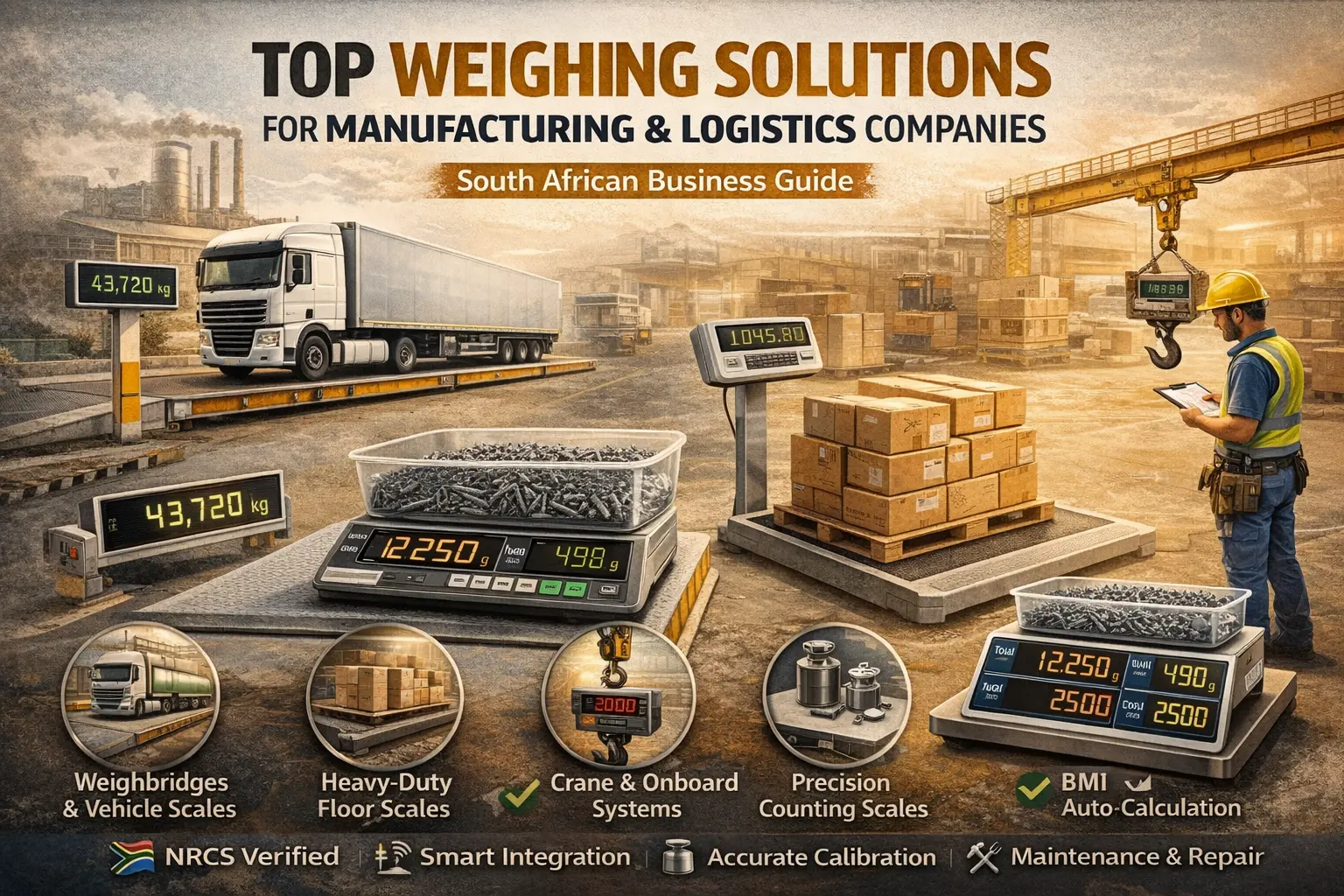
For any factory owner in South Africa or a warehouse manager in Johannesburg, the cost of a small mistake can be huge. If your measurements are wrong by even a few grams on a large shipment, you could lose thousands of Rands or face heavy fines from road authorities. Many businesses struggle with slow weighing processes that create traffic jams at dispatch bays or lead to incorrect stock levels. This guide solves those problems by showing you exactly which tools will make your operations faster and more profitable. Choosing the right industrial scales is the first step toward a smoother business that meets every local law.
Heavy-Duty Logistics: Weighbridges and Vehicle Scales
The government is very strict about truck weights to protect our roads from damage. If your logistics company sends out trucks that are too heavy, you will face massive fines at traffic checkpoints. A weighbridge is a large, ground-based scale that measures the weight of the entire vehicle. These are essential for bulk transport companies dealing with mining, agriculture, or shipping. You can choose a surface-mounted version that sits on top of the concrete or a pit-mounted version that is level with the ground.
The Role of Axle Weighers in Fleet Safety
While a full weighbridge tells you the total weight, an axle weigher checks how the weight is spread across the truck’s wheels. Sometimes a truck is not over the total limit, but one side is too heavy, which makes the vehicle dangerous to drive on the highway. These smaller, portable scales help drivers check their loads quickly at any warehouse bay. This keeps your drivers safe and helps your tires last longer because the weight is spread evenly. Keeping these scales in good shape is vital, so regular maintenance and repair should be a part of your monthly safety plan.
Warehouse Efficiency: Platform and Floor Scales
Every busy warehouse needs a “workhorse” scale that can handle pallets and large crates all day long. Floor scales are the most common choice because they are very tough and sit low to the ground. This low height is important because it allows workers to push a pallet jack directly onto the scale without needing a forklift. In a fast-paced logistics hub, this saves several minutes on every single shipment. Many of these scales now come with digital screens that can connect to your office computer, so your stock records are updated the moment a pallet is weighed.
Top Features for South African Logistics
When you pick a floor scale, you need to look at the material it is made of. South African factories can be dusty or wet, so a scale with a stainless steel top plate is often the best choice because it won’t rust. You also want a scale with “high-strength” steel that won’t bend if a heavy pallet is dropped on it. Having a bright digital display is also a big help for workers who need to read numbers quickly in dimly lit warehouses. If you are just starting or have a short project, you can even look at hiring a scale to save on costs while still getting the best technology.
Manufacturing Precision: Bench and Counting Scales
Manufacturing is all about making sure every box contains the exact same number of parts. If you sell a box of 500 bolts and there are only 490 inside, your customer will be unhappy. If there are 510, you are giving away your profit for free. This is where counting scales become a hero for your business. These machines use the weight of a small sample to count thousands of pieces in seconds. This is much faster and more accurate than having a staff member count by hand, which almost always leads to mistakes after a long shift.
The Power of Bench Scales for Packaging
Bench scales sit on a table or workstation and are used for smaller items that need to be weighed before they go into a box. These are perfect for food production or small part assembly where you need to check the weight of every individual pack. A good bench scale is fast and has an “auto-tare” feature that subtracts the weight of the packaging automatically. By using these precision scales, you ensure that every product leaving your factory is perfect, which builds trust with your customers.
| Scale Type | Best Use Case | Benefit |
| Weighbridge | Bulk Logistics & Mining | Avoids road fines |
| Floor Scale | Pallets & Large Crates | Fast pallet jack access |
| Counting Scale | Small Parts & Hardware | Prevents stock loss |
| Bench Scale | Packaging & Assembly | Ensures product consistency |
Advanced Logistics Systems and Smart Integration
Industrial operations in South Africa are moving away from simple, standalone machines toward fully connected ecosystems. For manufacturing and logistics managers, the goal is no longer just “getting a weight”, it is about getting that weight into a database instantly to improve decision-making. By using top weighing solutions for manufacturing & logistics companies, businesses can automate data entry and significantly reduce human error.
Specialized Weighing: Crane and On-Board Systems
In sectors like steel manufacturing or Durban’s shipping yards, floor space is often limited, or items are too large to sit on a platform. Crane scales solve this by weighing loads while they are suspended in mid-air. These scales are designed to be extremely safe, featuring high-strength shackles and hooks that can handle weights from 500kg to over 30 tons.
Many modern crane scales also feature wireless handheld indicators, allowing operators to read the weight from a safe distance. Similarly, “on-board” weighing, such as pallet jack scales, allows your team to weigh goods while they are moving from the racking to the loading dock, cutting out the need for a separate stop at a floor scale.
The Legal Requirement: NRCS and SANAS in South Africa
If your business sells products based on their weight, you are legally required to use “trade-approved” equipment. This means the scale must be verified according to the Legal Metrology Act and carry an NRCS (National Regulator for Compulsory Specifications) type approval. While “calibration” checks if a scale is accurate, “verification” is the official legal stamp that proves the scale meets government standards for trade.
Partnering with a verified service provider ensures that your company is protected from legal disputes and costly fines. It is important to remember that these certificates usually need renewal every two years, or whenever the scale undergoes a major repair.
Smart Factory Integration: Data & IoT
The future of South African manufacturing lies in the Internet of Things (IoT). Modern scales are no longer isolated; they are connected via Wi-Fi, Bluetooth, or RS-232 ports directly to Enterprise Resource Planning (ERP) systems like SAP or Sage. This means that as soon as a pallet hits the scale, the weight is automatically recorded in your inventory software.
This level of integration provides total traceability, making it easy to track “shrinkage” or stock loss in real-time. It also simplifies the shipping process, as weights for Bill of Lading (BOL) documents can be generated automatically, reducing the paperwork burden on your warehouse staff.
Maintaining Your Advantage and Local Support
Choosing the right technology is the first step, but keeping that technology running perfectly is how a business stays profitable. In a busy manufacturing or logistics environment, your scales are under constant pressure. To avoid expensive downtime and ensure your inventory stays 100% accurate, you must follow a proactive care plan.
Maintenance and After-Sales Support: Protecting Your Investment
A high-quality industrial scale can last for decades if it is looked after. Our harsh environments, from the humid coast of KwaZulu-Natal to the dusty plains of the Free State, can take a toll on electronic sensors. Regular maintenance is not just about cleaning; it is about catching small issues before they become “line-stopping” disasters.
We recommend a professional inspection every six to twelve months. During these visits, a technician will check for physical damage, ensure the load cells are not drifting, and verify that all software is communicating correctly. If you ever notice the scale acting strangely, it is best to call for emergency repairs immediately rather than waiting for your next scheduled service.
5 Signs Your Industrial Scale Needs a Professional Check
How do you know when your scale is starting to fail? Look out for these “warning lights” in your daily operations:
Inconsistent Readings
When the same pallet or item shows different weights each time it’s placed on the scale, this inconsistency points to failing sensors or calibration drift. Over time, environmental factors, heavy usage, or wear can affect accuracy, making it crucial to have the scale professionally inspected.
Unstable Display
If the numbers on your display jump or “drift” even when the load remains still, the issue likely lies in the scale’s electrical system. Unstable readings can stem from faulty wiring, damaged load cells, or interference in the signal pathway, requiring expert diagnosis to ensure reliable results.
Physical Corrosion
Rust or visible corrosion on the platform, cables, or junction boxes can lead to serious damage within your scale. Moisture or chemical exposure can weaken metal parts and disrupt internal connections, eventually causing inaccurate readings or a full system breakdown.
Slow Response Time
When your scale takes noticeably longer to display a final weight, it could be due to a struggling processor or outdated software. This issue can reduce efficiency in industrial operations and may indicate that internal components need recalibration or replacement.
Frequent Error Codes
If “OL” (Overload) or other error messages appear repeatedly, your scale’s internal electronics may be under stress. Such codes often signal that sensors, load cells, or circuits are nearing failure, an issue best handled by qualified technicians before operations are affected.
Frequently Asked Questions (FAQs)
1. Which scale is best for a warehouse in South Africa?
For most general logistics applications, a low-profile floor scale is the best option. It’s designed to handle heavy pallets and can be easily loaded using a pallet jack, making it ideal for busy warehouse environments.
2. What is the difference between calibration and NRCS verification?
Calibration is a performance check to ensure your scale provides accurate readings, while NRCS verification is a legal requirement. The National Regulator for Compulsory Specifications (NRCS) must verify that your scale meets government standards for trade use, especially if you sell goods by weight.
3. Can I use a standard scale for international shipping (SOLAS)?
No, you cannot. For SOLAS (Safety of Life at Sea) compliance, international shipping laws require certified scales to verify the Gross Verified Mass (VGM) of containers. This ensures ship stability and safety during transit.
4. How much does an industrial weighbridge cost?
The cost of a weighbridge depends on its size, configuration, and installation type, whether pit-mounted or surface-mounted. Because of these variables, it’s best to request a custom quote based on your site layout and operational needs.
5. How often should industrial scales be serviced?
It’s recommended to have industrial scales professionally serviced every 6–12 months, depending on usage levels and environmental conditions. Regular maintenance helps prevent breakdowns, maintain accuracy, and extend the lifespan of your equipment.
Conclusion
In the world of manufacturing and logistics, precision weighing is more than just a task, it is an investment in your company’s profit and reputation. By selecting the top weighing solutions for manufacturing & logistics companies in South Africa, you are choosing to work faster, avoid legal fines, and keep your customers happy. From the smallest parts counted on a bench to the largest trucks measured on a weighbridge, every gram matters. Don’t leave your accuracy to chance. Contact the experts at Scales4U today for a site audit and find the perfect weighing partner for your business.