

Selecting the wrong weighing equipment for your facility can lead to costly operational bottlenecks, broken sensors, and even legal fines if your measurements aren’t compliant. Many South African business owners find themselves stuck with a bench scale that is too small for their bulk shipments or a platform scale that lacks the fine precision needed for small ingredient batching. At Scales4U, we often see these mistakes, usually because the line between these two types of equipment can seem blurry. Understanding the functional differences between platform-scale and bench-scale equipment ensures you buy the right tool for your workload, whether you are running a retail deli in Johannesburg or a massive logistics warehouse in Durban.
What are Bench Scales?
Bench scales are the go-to solution for workstations where accuracy and portability are more important than sheer strength. These scales usually have a capacity ranging from 1kg up to about 150kg, making them perfect for weighing parcels, food portions, or small manufacturing parts. Because they are used on tables or counters, they are designed with ergonomics in mind, often featuring an integrated display screen at eye level. One of their biggest strengths is high resolution, which means they can detect tiny changes in weight that a larger scale would miss. They often come with advanced software for parts counting or checkweighing, which helps staff quickly verify that a box contains the correct number of items. They often come with advanced software for parts counting, which helps explain how counting scales work to verify inventory in seconds.
What is Platform Scales?
Platform scales are the backbone of the shipping and receiving sectors, designed to live on the floor and take a beating from heavy loads. These units start at 300kg and can reach several tons, featuring a much larger surface area to accommodate wooden pallets or large drums. Unlike bench scales, platform scales often have a remote indicator, which is a display screen connected by a long cable. This allows the screen to be mounted on a wall or a separate stand so it doesn’t get crushed when a forklift drops a heavy load onto the platform. Because they handle so much weight, they are built with thick mild steel or stainless steel frames and usually contain four high-capacity load cells, one in each corner, to ensure the weight is balanced correctly.
Head-to-Head Comparison: Breaking Down the Specs
While both machines serve the same fundamental purpose, measuring weight, the primary difference lies in their physical scale, weight capacity, and where they sit in your workflow. A bench scale is a compact unit designed for tabletop use, providing high-resolution measurements for smaller items. In contrast, a platform scale is a large, heavy-duty floor unit built to handle bulk loads, pallets, and massive industrial containers. Interestingly, a bench scale is technically a smaller version of a platform scale, but the engineering inside changes as the capacity increases. For most South African businesses, the choice depends on whether the operator is lifting the item by hand onto a table or moving it with a pallet jack across the floor.
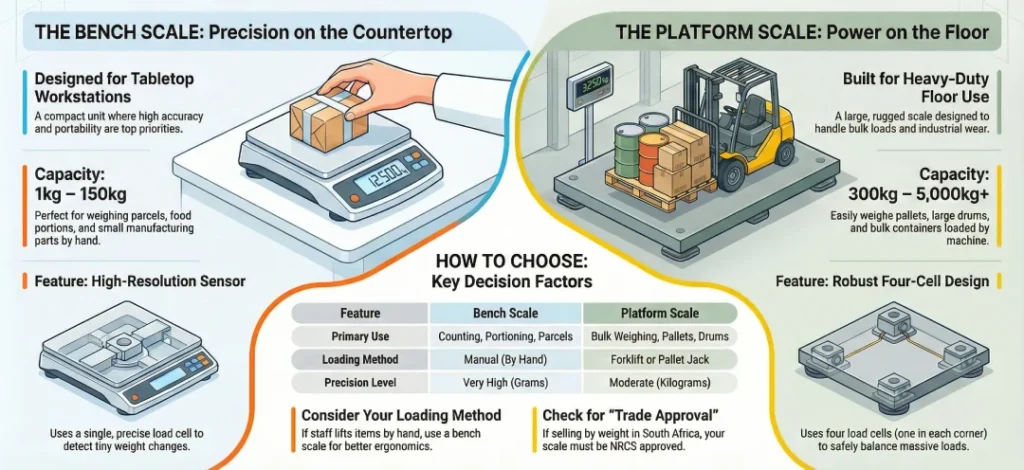
When you are looking at your budget and your operational needs side-by-side, it helps to see the technical specifications in a clear format. This table highlights why a warehouse might need both types of scales at different points in their production line.
| Feature | Bench Scale | Platform Scale |
| Typical Capacity | 1kg – 150kg | 300kg – 5,000kg |
| Mounting Style | Tabletop / Workbench | Floor / Pit Mounted |
| Precision Level | Very High (Grams) | Moderate (Kilograms) |
| Portability | Easy to carry by hand | Requires a pallet jack to move |
| Primary Use | Counting, portioning, parcels | Bulk weighing, pallets, drums |
| Loading Method | Manual (Hand-loaded) | Forklift or Pallet Jack via Ramp |
How to Choose for Your Facility
Selecting between a bench and a platform scale is not just about the weight of your products, but how those products move through your facility. The Rule of Weight is a helpful starting point: if your heaviest item regularly exceeds 80% of a bench scale’s capacity (usually 150kg), it is time to move to a platform scale to avoid overloading the sensors. Another major factor is the Method of Loading. If your staff is lifting items by hand to waist height, a bench scale is the safer, more ergonomic choice. However, if your items are moved on a pallet jack or a forklift, you need a low-profile platform scale that can be placed on the floor, often with a ramp for easy roll-on access.
Technical Synergy: Indicators and Connectivity
While the physical bases of these scales are different, they often share the same brain, the digital indicator. These display units are the interface where your staff reads the weight, and in modern South African industry, they are expected to do much more than just show a number. Both bench and platform scales can be equipped with indicators that offer RS-232, USB, or even Wi-Fi connectivity. This allows your scale to talk directly to your inventory management software or a label printer. At Scales4U, we often help businesses integrate their scales into automated systems, ensuring every measurement is logged digitally and removing the risk of human error in manual record-keeping.
Trade Approval: Legal Requirements in South Africa
If you are using your scale to determine a price for a sale, for example, weighing a parcel for shipping fees or weighing a crate of vegetables for a wholesaler, your scale must be Trade Approved. In South Africa, this means the scale model has been evaluated by the National Regulator for Compulsory Specifications (NRCS) and carries a valid verification sticker. Both bench and platform scales can be trade-approved, but they must undergo specific testing to ensure they stay accurate within legal limits. Using a non-approved scale for commercial transactions can lead to heavy fines and the confiscation of your equipment, so it is vital to verify the NRCS status of your equipment before you buy.
Understanding Load Cell Configurations
The internal technology that makes a scale work is the load cell, and the configuration of these sensors differs greatly between the two types of scales. Most bench scales use a Single-Point load cell. This is a highly precise sensor located directly in the center of the base, which is designed to provide an accurate reading even if the item is placed slightly off-center on the small platform. Platform scales, due to their larger size and heavier loads, typically use a Four-Cell configuration. One load cell is placed in each corner of the frame, and their signals are combined in a junction box. This robust design allows the scale to handle the massive pressure of a fully loaded pallet without damaging the delicate electronics inside.
Environmental Suitability (Hygienic vs. Industrial)
The environment of your workspace dictates the material your scale should be built from, regardless of whether it is a bench or platform model. In South African food-processing or chemical plants, equipment is often exposed to corrosive liquids and to daily high-pressure cleaning. In these cases, you must choose a stainless steel scale with an IP67 or IP68 rating to prevent water from frying the electronics. For dry warehouses or shipping hubs, a powder-coated mild steel scale is usually sufficient and more cost-effective. However, if your platform scale is installed in a pit where water can pool, or if your bench scale is used in a damp butchery, choosing the wrong material will lead to rust and sensor failure within months. Regardless of the size, our industrial scales provide a deep dive into choosing the right metal for corrosive environments.
Maintenance and Longevity Secrets
A weighing scale is a precision instrument, and its lifespan depends on how well it is maintained. For platform scales, the biggest threat is shock loading, which happens when a forklift drops a pallet too quickly onto the platform, potentially crushing the load cells. For bench scales, the primary risk is overloading, or placing an item that exceeds the maximum capacity, which can permanently bend the single-point sensor. Regular cleaning is also vital; debris like dust, grain, or small stones can get trapped under the platform or the bench pan, causing phantom weight readings. At Scales4U, we recommend a simple weekly check to ensure the scale is level and the area beneath the weighing surface is clear of obstructions.
Calibration: Ensuring Long-Term Accuracy
Calibration is the process of testing and adjusting the scale using known standard weights to ensure the reading on the screen is accurate. Over time, all scales experience drift due to mechanical wear or temperature changes. Bench scales used for high-precision work may need more frequent calibration because even a small error of a few grams can ruin a recipe or a chemical batch. Platform scales, while rugged, should be calibrated at least once or twice a year by a professional service team. This is especially important for South African businesses that need to maintain their ISO certification or NRCS compliance, as an uncalibrated scale can lead to failed audits and financial loss.
Conclusion: Investing in the Right Tool
In summary, the choice between a bench scale and a platform scale comes down to the size of your load and the location of the weighing task. Bench scales offer the portability and precision needed for tabletop work, while platform scales provide the brute strength and surface area required for bulk industrial logistics. Buying a scale that is too small for your needs will lead to broken sensors while buying one that is too large might cause you to lose the fine precision your business requires. By understanding these differences, you can make an informed investment that keeps your production line moving efficiently. If you are still unsure which model fits your facility, the team at Scales4U is ready to help you find the perfect weighing solution.
FAQ: Platform Scale vs. Bench Scale
Can a platform scale be used as a bench scale?
While you can technically place a small item on a large platform scale, it is usually not a good idea. Platform scales have a lower resolution, meaning they might only count in increments of 500g or 1kg. If you need to weigh something that is only 2kg, the platform scale won’t be nearly as accurate as a bench scale that measures in 1g or 5g increments.
Are platform scales less accurate than bench scales?
Not necessarily. Accuracy is about how close the reading is to the true weight. Both types of scales can be highly accurate. The difference is resolution. Bench scales are designed to show very small units (like grams), while platform scales are designed to show very large units (like kilograms). A platform scale is just as accurate for a 1-ton pallet as a bench scale is for a 5kg box.
What is a Pit Mounted platform scale?
A pit-mounted scale is a platform scale installed in a hole in the floor so that the weighing surface is perfectly flush with the ground. This is a popular choice in South African warehouses because it allows staff to roll pallet jacks or trolleys directly onto the scale without needing a ramp, saving valuable floor space and reducing the risk of tripping.
Do I need a ramp for my platform scale?
If your platform scale sits on top of the floor (surface mounted) and you plan to use a pallet jack to load it, then yes, you will need a ramp. Without a ramp, you would need a forklift to place every load onto the platform. Ramps make the process much faster and safer for warehouse staff who are moving goods manually.
Which scale type lasts longer?
If used within their weight limits and kept in the correct environment, both types can last for many years. However, platform scales are generally built with thicker steel to handle harsher industrial environments. Bench scales are more delicate and can be damaged more easily if they are dropped or if someone accidentally sits on them.