

Weighing scales are vital tools in various industries, from manufacturing and laboratories to healthcare and retail. Their primary function is to ensure accurate measurements, which are crucial for inventory control, quality assurance, and patient care. However, environmental factors, particularly temperature fluctuations and other physical conditions, can significantly impact the accuracy of weighing scales.
Inaccurate readings due to temperature fluctuations, humidity, or vibrations can lead to operational inefficiencies, incorrect product measurements, and even regulatory issues. Therefore, businesses and healthcare providers need to understand how these factors affect scale performance and how to mitigate these challenges.
How Temperature Affects Weighing Scale Accuracy
1. Temperature and Load Cell Performance
Load cells are a critical component of most modern weighing scales. They function by converting the applied force (weight) into an electrical signal. However, load cells are sensitive to temperature fluctuations, which can lead to resistance changes within the load cell’s strain gauges. This can result in inaccurate readings, especially if the scales are not calibrated to account for temperature-induced variations.
When the temperature changes, the resistance of the load cell’s strain gauges also changes, which affects the load cell’s ability to produce accurate measurements. This can lead to zero drift, where the scale’s baseline shifts, or non-linear readings, where measurements at higher weights are more affected than lower ones. In extreme cases, these changes can cause complete system failure if not addressed.
Temperature fluctuations can also affect the calibration of the load cell, leading to drift in the zero point and causing measurement errors. This is particularly problematic in industries that rely on high-precision measurements, such as pharmaceuticals and food processing, where slight weight differences can have significant consequences.
2. Expansion and Contraction of Scale Components
The materials that make up a weighing scale, including metal components and structural parts, can expand or contract with temperature changes. For instance, aluminium and stainless steel, which are commonly used in scale construction, are particularly susceptible to these changes. Because different metals react uniquely to thermal stress, choosing between mild steel vs stainless steel floor scales is vital; stainless steel generally offers better resistance to the expansion-induced misalignments common in fluctuating temperatures.
When temperatures rise or fall, the expansion or contraction of these materials can cause misalignments in the scale components, leading to imprecise readings. For instance, if the weighing platform expands at a different rate than the load cell, it could distort the measurements being recorded. Over time, these subtle changes can lead to persistent errors unless regularly calibrated.
Extended exposure to temperature changes can cause long-term damage to the weighing scale’s internal components, leading to inaccurate readings or even permanent failure. Regular maintenance and calibration are necessary to prevent this from happening, especially in environments with wide temperature ranges.
3. Common Temperature-Related Problems in Weighing Scales
Zero drift is a common issue caused by temperature fluctuations. When the zero point shifts, the scale may display weight readings even when no load is applied. Recalibration is needed to reset the scale to its proper zero point, ensuring accurate weight measurements.
In industries that require high-precision measurements, such as pharmaceuticals or chemical manufacturing, even small temperature-induced shifts can cause large errors. This could lead to faulty product measurements, affecting everything from product quality to compliance with industry regulations.
Other Environmental Factors That Affect Weighing Scale Accuracy
1. Humidity and Moisture Effects
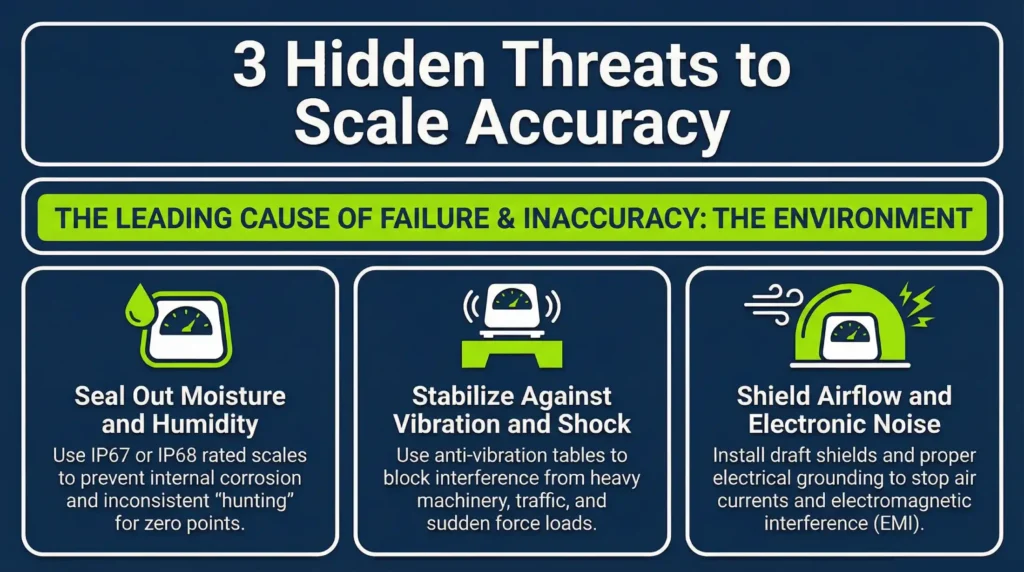
Moisture ingress is another environmental factor that can cause damage to weighing scales, especially in humid or wet conditions. When moisture seeps into the scale’s components, it can corrode load cells, wiring, and other sensitive parts, leading to inaccurate readings or even complete failure.
Humidity can alter the electrical properties of the load cell, leading to erratic readings. Over time, prolonged exposure to moisture can cause the internal components to degrade, making it more difficult for the scale to function properly. This is a critical issue in industries like food processing or pharmaceuticals, where cleanliness and accuracy are paramount. High humidity can cause microscopic condensation inside a junction box, which is a primary reason for scales giving inconsistent readings or ‘hunt’ for a stable zero point even when the platform is empty.
To combat these issues, scales used in humid environments should be rated with IP67 or IP68 for moisture resistance. This will help prevent damage from water or moisture, ensuring the longevity and accuracy of your equipment. Additionally, using draft shields and anti-vibration tables can further protect the scale from environmental contaminants.
2. Vibrations and Shock Loads
Vibrations from nearby machinery, traffic, or even foot traffic can cause disturbances in the weighing system, leading to inconsistent readings. In industrial environments, this is a common problem, especially in factories where heavy machinery is running continuously.
Vibrations can cause load cells to register inaccurate readings by interfering with the electrical signals that the load cells produce. This is particularly problematic when precise weight measurements are required, such as in scientific experiments or quality control processes.
Similarly, shock loading, where a sudden force is applied to the scale, can cause physical damage to the load cells. This could lead to permanent damage or misalignment that affects the scale’s ability to provide accurate readings.
To protect your weighing system, consider using anti-vibration tables or placing scales on stable platforms. If possible, avoid placing scales near machinery that generates excessive vibrations. These solutions help ensure more accurate and consistent measurements.
3. Airflow and Electromagnetic Interference (EMI)
Airflow, especially in lab environments or production floors, can cause the scale’s load cells to give fluctuating readings. This is because even slight air currents can disturb the force being applied to the load cell.
Electromagnetic fields or electrostatic charges from nearby electrical equipment or machinery can disrupt the signal transmission from load cells to the scale’s display, leading to inaccurate measurements. To protect against these issues, use draft shields and ensure your scale is placed in an environment with controlled airflow. Additionally, ensure that the weighing system is shielded from electromagnetic interference using proper grounding and electrical shielding.
Solutions for Mitigating Environmental Impacts on Weighing Scale Accuracy
1. Proper Scale Placement and Environmental Controls
Proper scale placement is essential for minimizing the effects of temperature fluctuations, humidity, and vibrations. Scales should be placed in stable, climate-controlled environments where external factors like temperature and humidity are kept in check.
Key Placement Guidelines:
- Place scales away from heat sources, air conditioners, or ventilation systems that can cause temperature fluctuations.
- Use climate-controlled rooms or enclosures for high-precision weighing systems to prevent environmental interference.
Tip: Consider placing scales in stable, temperature-controlled rooms to mitigate the impact of environmental factors like temperature extremes and humidity.
2. Choosing Scales with Appropriate Environmental Ratings
For scales used in harsh conditions, it is critical to choose models with IP-rated protection to prevent moisture, dust, or chemical exposure from causing damage.
Key Features to Look for:
- IP67 or IP68 rating for moisture protection.
- Temperature compensation features for scales used in extreme temperatures.
Tip: Look for scales that are designed to operate in tough environments, ensuring that your equipment remains protected and accurate despite external conditions.
3. Routine Calibration and Maintenance
Routine calibration ensures that the scale continues to provide accurate measurements, especially as environmental conditions change. Regular maintenance and inspections can also help prevent issues like moisture ingress or vibration damage.
Key Maintenance Tasks:
- Calibration at regular intervals.
- Inspection for wear and tear, especially after exposure to temperature extremes or high-humidity environments.
Tip: Schedule periodic calibration and maintenance checks to ensure that your scales remain reliable over time.
Troubleshooting and Fixes for Weighing Scale Failures
1. Testing Load Cells with a Multimeter
Multimeter testing is one of the most straightforward methods to identify potential electrical failures in weighing scales, particularly in load cells. By measuring resistance and continuity, technicians can detect issues that affect signal integrity and weigh scale performance.
How to Test with a Multimeter:
- Check for continuity: Ensure that there are no breaks in the wiring or connections that could disrupt the signal.
- Measure resistance: Load cells should have specific resistance values when under load. A significant deviation from the standard could indicate that the internal sensors are damaged.
Tip: Performing multimeter tests at regular intervals can help detect early signs of load cell failure or electrical issues, ensuring your system stays in optimal working condition.
2. Recalibrating the Weighing Scale
A crucial step in addressing temperature-induced errors or environmental interference is to recalibrate the weighing scale. Calibration ensures that the scale remains accurate despite external fluctuations.
Calibration Process:
- Step 1: Clear the scale of any load and set it to zero. If zero drift has occurred, this step will help reset the baseline.
- Step 2: Use calibration weights that match the scale’s maximum capacity to apply a known load. Adjust the scale’s readings according to the calibration weights.
- Step 3: Regularly recalibrate based on your environment, especially after significant temperature changes, vibration disturbances, or moisture exposure.
Tip: For industrial or laboratory scales, it’s essential to recalibrate after exposure to significant environmental shifts, such as temperature extremes or humidity changes, to maintain accurate results.
3. Replacing Damaged Load Cells and Components
When physical damage occurs, whether through shock loading, moisture ingress, or corrosion, it may be necessary to replace the damaged load cells or other internal components.
Steps for Replacement:
- Step 1: Inspect the load cell for visible damage or signs of corrosion. Look for cracks, wear, or other structural defects.
- Step 2: Disconnect the load cell from the system. Ensure that the power is off, and take necessary precautions for electrical safety.
- Step 3: Replace the damaged components with OEM parts to ensure compatibility and optimal performance.
Tip: Use original parts from your load cell supplier to maintain the integrity of the scale. If you’re unsure about the compatibility, consult the manufacturer or a specialist for guidance.
4. Protecting Scales from Environmental Factors
Preventing environmental damage is key to ensuring the longevity of weighing scales and preventing errors caused by temperature fluctuations, humidity, or electromagnetic interference.
Protective Measures:
- Sealed Enclosures: Use IP67 or IP68-rated load cells for moisture and dust protection, ensuring they’re suitable for harsh environments like food processing plants or laboratories.
- Temperature-Controlled Environments: Place your scales in climate-controlled rooms to avoid issues caused by extreme temperatures. Avoid placing scales near heating or cooling systems that could create fluctuations.
- Vibration Dampening: Install scales on anti-vibration tables or secure the surrounding environment to reduce the impact of vibrations from machinery or foot traffic.
Tip: For environments where moisture is a concern, consider moisture-proof seals or desiccant packs inside the scale housing to protect load cells and electronic components.
5. Preventing Signal Interference and Electrical Issues
Signal interference from nearby electromagnetic sources or faulty connections can degrade the accuracy of weighing scales, especially in environments with high electrical activity.
Prevention Tips:
- Use Shielded Cables: Ensure that cables connecting the load cells to the scale display are shielded to prevent interference from electromagnetic signals.
- Proper Grounding: Ensure that the scale and its components are properly grounded to avoid the buildup of electrostatic charges, which can lead to errors in measurement.
- Electromagnetic Shields: In highly sensitive environments, consider using electromagnetic shielding to protect the scale from interference.
Tip: If your weighing system is located near high-voltage machinery or sources of electrical noise, install grounding systems and use shielded cables to protect against signal interference.
Preventative Measures and Long-Term Maintenance
1. Routine Inspections and Preventive Maintenance
Regular inspections and preventative maintenance are critical to ensuring that your weighing scales operate smoothly and deliver accurate results over time. These measures help detect small problems before they become costly repairs.
Maintenance Checklist:
- Inspect load cells for physical damage, such as cracks or corrosion.
- Check wiring for signs of wear or damage that could cause electrical issues.
- Test the scale’s calibration using calibration weights to ensure accuracy.
- Clean the scale regularly to prevent the buildup of dust or contaminants that could affect performance.
Tip: Keep a maintenance log to track the dates of calibration, inspections, and service performed on the scales. This can help identify any patterns or recurring issues over time.
2. Calibration and Software Updates
To maintain the accuracy of your weighing systems, it is crucial to keep both the hardware and software up-to-date. Calibration ensures that your scales remain precise, while software updates ensure that the system’s firmware remains optimized for new features and enhanced performance.
Key Calibration Recommendations:
- Perform calibration regularly, especially after environmental changes such as temperature fluctuations or moisture exposure.
- Software updates should be implemented as soon as new patches or features are released by the scale manufacturer.
Tip: For laboratory scales or systems that require high precision, use automated calibration tools that can adjust the scale for temperature shifts and other environmental factors.
3. Staff Training for Load Cell and Weighing Scale Operation
Proper handling of weighing scales is essential to prevent errors due to misuse or incorrect calibration. Training your staff ensures that they understand how to operate scales properly and how to troubleshoot common issues that arise.
Training Program Components:
- Load cell handling and calibration procedures.
- Troubleshooting basics, such as how to identify zero drift or inconsistent readings.
- Maintenance practices include cleaning and protecting the scale from moisture or electromagnetic interference.
Tip: Providing operational manuals and holding regular workshops will help ensure your team is well-prepared to manage your weighing systems.
Final Thought
External factors like temperature fluctuations, moisture, vibrations, and electromagnetic interference can significantly impact the accuracy of weighing scales. However, by understanding these factors and applying proper safeguards, businesses can ensure consistent and reliable measurements across all applications.
If you’re experiencing load cell issues or need professional calibration and maintenance services, Scales4U is here to help. Our team of experts can assist you in diagnosing issues, calibrating your load cells, and ensuring your weighing systems perform at their best. Contact us today for a free consultation and ensure the longevity and accuracy of your weighing scales.