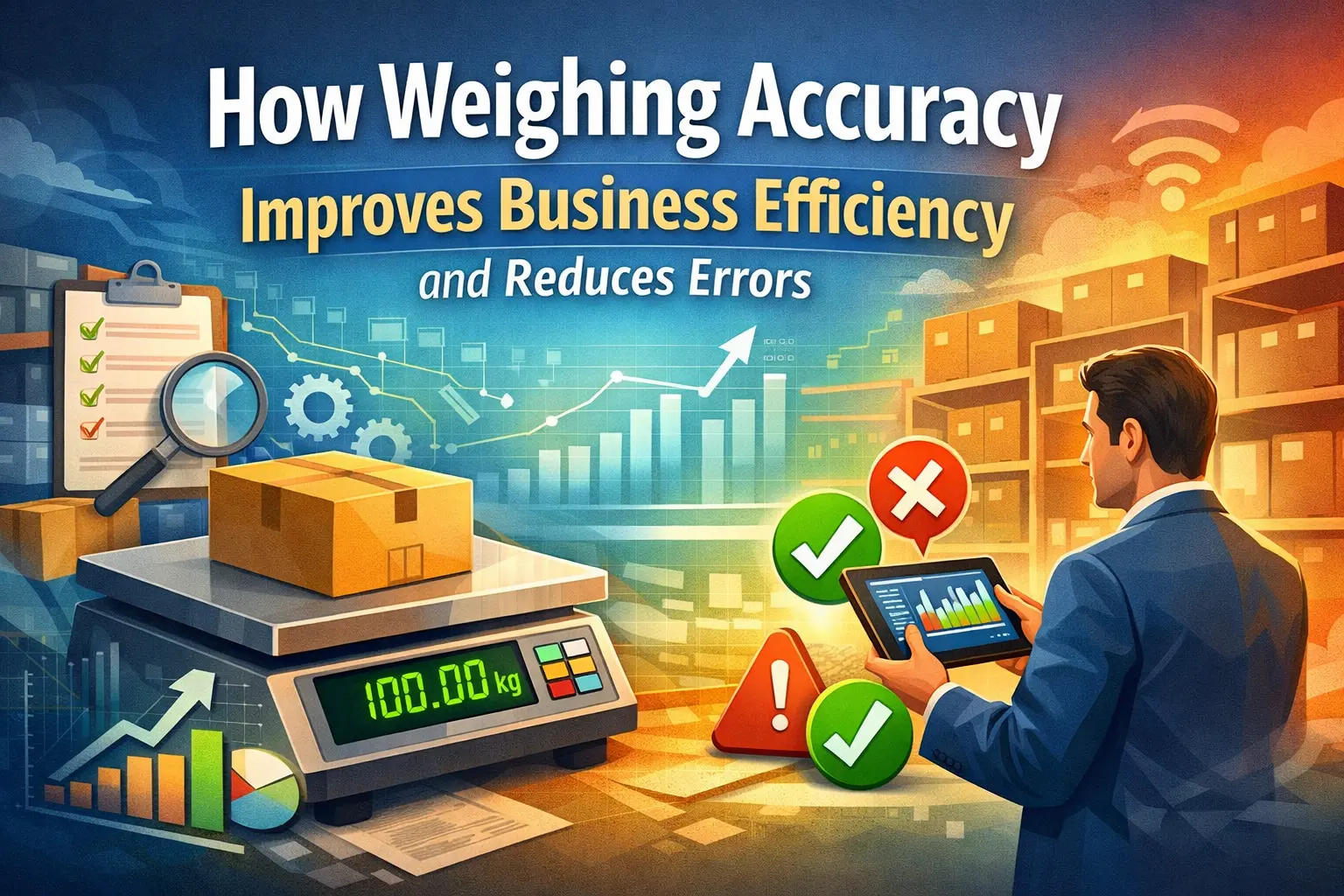
Have you ever stopped to calculate the real cost of a small weighing mistake? In manufacturing, overfilling 10,000 product packages by just 5 grams means you have given away 50 kilograms of expensive material for free. In logistics, an incorrect weight on a shipping document can lead to costly fines or delays at the port. These errors silently eat away at profits and create unnecessary waste. The solution is not to simply weigh more often, but to ensure every single reading is perfectly accurate. This guide explains exactly how weighing accuracy improves business efficiency and reduces errors by showing you where hidden costs lie and how precise weighing equipment solves them.
The Core Science: Defining Weighing Accuracy vs. Precision
Many people use the terms “accuracy” and “precision” as if they mean the same thing, but in industrial weighing, they describe two different qualities of a measurement system. Understanding the difference is the first step in fixing long-term operational problems.
Accuracy: Hitting the True Target
Accuracy describes how close a measured weight is to the item’s true weight. If a standard test weight is 10 kilograms, and your scale reads 10.005 kilograms, your scale is highly accurate. Low accuracy is often caused by a scale that has not been calibrated correctly or has been physically damaged. Improving accuracy requires professional calibration services to make sure the scale is balanced against official standards.
Precision (Repeatability): Hitting the Same Spot
Precision, or repeatability, describes how close repeated measurements are to each other. If you weigh the same 10-kilogram object five times and get readings of 10.005 kg, 10.005 kg, 10.006 kg, 10.004 kg, and 10.005 kg, your scale is very precise. Low precision is often caused by faulty load cells or environmental factors like vibration and air currents. For industrial applications in South Africa, a scale must be both accurate and precise to guarantee product quality.
The Importance of Low Standard Deviation
In the engineering and manufacturing sectors, the term Standard Deviation is used to measure precision. It tells you how much your measurements are spreading out. A low standard deviation means your weighing process is repeatable and reliable. By using high-quality laboratory scales or specialized industrial equipment with high internal resolution, you can dramatically lower the standard deviation in your weighing process, leading to greater consistency in all your products.
Financial Impact: Reducing Errors to Increase Profit
Inaccurate weighing directly impacts your financial statements, often through invisible leaks that are hard to track. When you tighten up your weighing procedures, you immediately see the benefits in reduced material costs and better inventory management.
Minimizing Material Overages
One of the highest hidden costs in any food, chemical, or component manufacturing facility is material overage. Companies often set their packing targets slightly higher than the labeled weight to avoid legal disputes about underfilling. However, if the scale is inaccurate, this “safety buffer” can become unnecessarily large. A highly accurate scale allows you to reduce this buffer to the smallest possible amount, saving money on every single product packaged. This optimization immediately reduces production costs by converting waste into profit.
Optimizing Inventory Control
Accurate weighing is the backbone of stock control. When you conduct physical inventory counts (PI counts) using an accurate counting scale, the numbers you enter into your system are reliable. Poor accuracy leads to unreliable stock figures, causing two major problems: over-ordering (wasting storage space and capital) or under-ordering (leading to costly production downtime or lost sales). By ensuring accuracy, your inventory data becomes trustworthy, eliminating guesswork from your purchasing department.
Factoring in Taring Errors
A taring error occurs when the weight of the container (the tare weight) is not correctly subtracted from the total weight. If your staff manually enters the tare weight of a box, and that box varies in weight due to moisture or physical wear, your final net weight will be wrong. Using modern digital scales with an automated tare function eliminates this common source of error, which is crucial when weighing valuable raw materials. This simple feature improves data integrity across the entire facility.
Operational Efficiency and Risk Reduction
Once a business achieves high weighing accuracy, the benefits immediately flow into faster operations and a significant reduction in legal and financial risk. Efficient processing and reliable data are key performance indicators for any successful manufacturing or logistics company.
Operational Efficiency: Speed and Automation
Manual processes are slow, and they introduce human error at every step. Modern weighing solutions are designed to automate tasks, allowing staff to move faster without sacrificing the precision that protects your profit margins.
Minimizing Labour Intervention
If a worker has to manually read a scale, write the number on a clipboard, and then type that number into a spreadsheet, there are three chances for error. Highly accurate industrial scales now come standard with data connectivity features (Wi-Fi, RS-232, or USB). This allows the scale to talk directly to your inventory or ERP system (like SAP or Oracle). This automation eliminates the time spent on manual data logging and frees up your staff to perform more valuable tasks, significantly increasing overall business efficiency.
Streamlining Batching and Formulation
Many manufacturing processes require mixing exact amounts of different ingredients. Any small error here can ruin an entire batch of product. Programmable scales use setpoint control, often displayed as clear “Go/No-Go” lights, to guide the operator. The scale is programmed with a target weight range; a green light confirms the correct weight, and a red light signals an underfill or overfill. This visual guide speeds up quality checks and minimizes formulation errors, ensuring every product batch is consistent.
Faster Throughput and Dynamic Weighing
Waiting for a large floor scale to settle can cause major traffic jams at the shipping dock. Modern weighing systems use advanced filtering and load cell technology to stabilize readings much faster. Dynamic Weighing technology is especially useful in situations like checking cartons on a fast-moving conveyor belt or weighing live animals, where movement is unavoidable. By quickly providing a stable, accurate weight, these systems reduce queue times and increase your facility’s overall processing capacity.
Reducing Risk: Compliance and Data Integrity
In South Africa, following regulations is not optional. Inaccurate weighing can expose a company to large fines, product recalls, and customer dissatisfaction, damaging the brand’s reputation.
Regulatory Compliance and Legal Fines
Businesses that sell products by weight (e.g., bulk food, chemicals, hardware) are subject to inspection under the Legal Metrology Act. The scale must be verified to ensure it is “legal for trade.” If a competitor or regulator finds that your product is consistently underfilled due to inaccurate scales, your company faces fines and potential prosecution. Accurate weighing provides the necessary data integrity to prove due diligence and maintain operational compliance.
Data Traceability and Audit Trails
When a shipment is damaged or a product batch fails a quality check, the first step in the investigation is checking the records. Highly accurate and connected scales automatically record the time, date, and weight of every measurement. This comprehensive audit trail is invaluable for defending your company against customer disputes, supply chain discrepancies, or mandatory government audits. The digital records from verified scales provide irrefutable proof of your internal quality control processes.
Patient Safety in Specialized Sectors
While the focus is on manufacturing and logistics, the principle of accuracy is life-critical in the medical sector. Inaccurate weighing of a patient can lead to dangerous errors in medication dosage. Using our certified, high-precision medical scales is essential for patient care and directly aligns with healthcare facilities.
Advanced Techniques: Maintaining Long-Term Accuracy
Even the most advanced scales will eventually drift from their certified weight. This is normal, but smart businesses prevent this drift from causing costly errors by setting up a formal maintenance schedule.
The Role of Calibration
Calibration is the act of testing the scale against known, certified weights to see how far the scale is from the true reading. This is a crucial internal quality check. If the scale is found to be off, a technician will adjust its internal settings to bring it back into specification. It is important to differentiate this from Verification (which is the legal stamp of approval). By scheduling routine calibration, you ensure your equipment stays precise between official inspection visits.
Environmental Factors and Hidden Errors
Many accuracy problems are not caused by the scale itself but by its working environment. Even small factors can introduce large errors:
- Vibration: Heavy machinery nearby can shake the scale’s load cells.
- Temperature: Large swings in temperature can cause metal components to expand or contract.
- Airflow: Strong drafts from an open door or HVAC system can push down on the scale platform, leading to inaccurate readings.
- Dirt/Dust: Debris trapped under the platform can restrict movement.
If you are experiencing accuracy issues, look at the environment before assuming the scale is broken. For highly sensitive weighing, investing in an anti-vibration table can isolate the precision scale from factory floor noise.
The ROI of Upgrading Your Weighing Solution
The decision to invest in a new, high-accuracy scale should be viewed as a project with a clear Return on Investment (ROI). The money you spend on the equipment will be paid back quickly by the material you stop giving away and the fines you avoid.
Calculating Payback Through Material Savings
Consider a factory packaging a chemical that costs R50 per kilogram. If the old, inaccurate scale causes you to overfill each 1kg bag by just 5 grams (0.005 kg), and you produce 10,000 bags a week:
$$\text{Material Loss per Week} = 10,000 \times 0.005 \text{ kg} \times \text{R}50/\text{kg} = \text{R}2,500$$
That translates to a loss of R130,000 per year. If a new, highly accurate scale costs R40,000, your payback period is just over 3 months. This simple math proves that investing in high-accuracy industrial scales is one of the fastest ways to increase your profit margin.
Case Study Example: Logistics and Error Reduction
A large South African logistics firm was dealing with daily delays because truck weights were being manually recorded and often conflicted with the weighbridge reading at the port. After implementing a high-accuracy, connected axle weigher at their dispatch bay, they automatically integrated the verified weight data into their shipping documents. This eliminated data entry errors, reduced truck re-weighing at the ports by 40%, and boosted overall customer satisfaction by ensuring all paperwork was correct before the load left the yard.
Conclusion
In any successful business, efficiency and accuracy are inseparable. If your weighing process is slow or unreliable, every step that follows is built on a weak foundation. How weighing accuracy improves business efficiency and reduces errors is clear: it saves material, speeds up operations through automation, and shields your company from costly regulatory fines.
By choosing verified, high-precision weighing equipment and committing to routine maintenance and calibration, you are making a smart investment in the long-term profitability and reputation of your South African business. Stop losing product to inaccurate readings today. Contact the professionals at Scales4U to find a solution that guarantees zero errors.