

In pharmaceutical laboratories, even the smallest error in weighing active pharmaceutical ingredients (APIs), excipients, or binders can compromise the safety, efficacy, and regulatory compliance of drugs. Accurate laboratory weighing scales are essential to ensure precise formulation development, drug discovery, and quality control. Whether you are preparing tablets, capsules, or conducting stability studies, using high-quality analytical balances, precision balances, and microbalances is vital to achieve traceable measurements, minimize cross-contamination, and maintain controlled environments in your lab.
This guide explains the critical role of weighing scales in pharmaceutical labs, explores the types of balances used, highlights calibration and contamination prevention, and provides practical guidance for South African laboratories seeking reliable weighing solutions for research, production, and compliance.
Why Accurate Weighing Matters in Pharmaceutical Laboratories
Accuracy and precision in pharmaceutical weighing are foundational for patient safety, regulatory compliance, and consistent dosage forms. Incorrect measurements during sample preparation, compounding, or formulation validation can lead to ineffective medications or harmful overdoses. In research and production, even microgram-level measurements of APIs or nanogram-level adjustments in biopharmaceutical formulations require analytical balances with exceptional precision.
Accurate weighing is critical across all stages:
- Formulation Development: Ensuring correct ratios of binders, disintegrants, and active ingredients for tablets and capsules.
- Drug Discovery: Precise weighing of experimental compounds for reproducibility in pharmaceutical research laboratories.
- Quality Control: Maintaining batch uniformity, verifying dosage accuracy, and producing reliable laboratory records for regulatory audits.
Without proper calibration, verified traceable measurements, and controlled weighing environments, even minor errors can result in cross-contamination, inaccurate analysis, and failed quality checks, ultimately affecting both research outcomes and patient health.
Core Functions of Weighing Scales in Pharmaceutical Workflows
Laboratory weighing scales serve multiple critical functions across pharmaceutical workflows, ensuring that measurements are accurate, repeatable, and compliant. Understanding these roles helps South African labs optimize their workflow efficiency and meet regulatory requirements.
Formulation Development
Weighing scales are essential for measuring APIs, excipients, binders, and disintegrants during formulation development. Accurate weighing ensures that each dosage form, whether tablets, capsules, or other pharmaceutical preparations, meets quality standards. Scales like analytical balances or precision balances allow scientists to weigh small quantities of active compounds with microgram-level precision, which is critical for drug uniformity and stability.
Drug Discovery & Research
During drug discovery, researchers handle experimental compounds that require nano- or microgram-level measurements. Laboratory weighing scales, such as microbalances and analytical balances, enable precise measurements needed for pharmaceutical research, toxicity testing, and impurity analysis. This precision supports accurate biopharmaceutical studies, including protein characterization, and ensures reliable scientific outcomes.
Quality Control and Assurance
In QC labs, accurate weighing guarantees batch uniformity, dosage accuracy, and regulatory compliance with standards like GMP, ISO, or FDA requirements. Scales facilitate verification protocols, traceable measurements, and documentation for audits. Instruments equipped with draft shields, anti-vibration features, and internal calibration help maintain precision during high-throughput testing.
Compounding & Manufacturing Support
Weighing tasks in compounding and production involve measuring bulk powders, liquid excipients, and high-potency APIs. Top-loading balances, precision balances, and industrial weighing scales such as Clover Scales or worktop bench scales are used to maintain accuracy in heavy-duty applications while preventing cross-contamination.
Stability Studies & Reference Measurements
For stability studies, reliable laboratory weighing solutions provide precise measurements over time, ensuring the consistency of active ingredients and excipients in various environmental conditions. Scales calibrated with reference standards ensure repeatability, reproducibility, and data integrity, essential for both R&D and production phases.
Types of Weighing Scales Used in Pharmaceutical Laboratories
Pharmaceutical laboratories rely on various laboratory weighing scales designed for precision, accuracy, and reliability. Choosing the right balance depends on the weighing tasks, sample type, and regulatory requirements.
Analytical Balances
Analytical balances are high-precision instruments capable of measuring microgram-level differences. They are used for weighing APIs, excipients, and small quantities of binders or disintegrants. Key features include draft shields to prevent environmental interference, internal calibration, and anti-static measures to ensure traceable measurements.
Microbalances and Semi-Micro Balances
These scales are essential for nanogram- and microgram-level measurements in drug discovery, protein characterization, and impurity analysis. They provide repeatable and reproducible readings critical for biopharmaceutical research and stability studies, ensuring dosage accuracy in highly potent compounds.
Top-Loading and Precision Balances
Top-loading balances provide fast, high-capacity weighing for bulk powders, sample preparation, and compounding. Precision balances offer a compromise between speed and accuracy, suitable for QC labs requiring microgram-level precision without the constraints of ultra-fine balances.
Moisture Analyzers / Moisture Balances
Moisture analyzers measure loss on drying (LOD) for powders, excipients, and dosage forms. Accurate moisture content is vital for tablet stability, preventing degradation, and ensuring regulatory compliance. These balances are crucial in both R&D and production environments.
Portable and Compact Balances
Portable balances are used for cross-lab checks and field measurements in industrial and pharmaceutical production. Compact designs allow easy integration into controlled environments and glove boxes, minimizing cross-contamination risks.
Key Features & Specifications That Matter
Selecting the right balance goes beyond capacity; features determine accuracy, workflow efficiency, and compliance.
Readability and Sensitivity
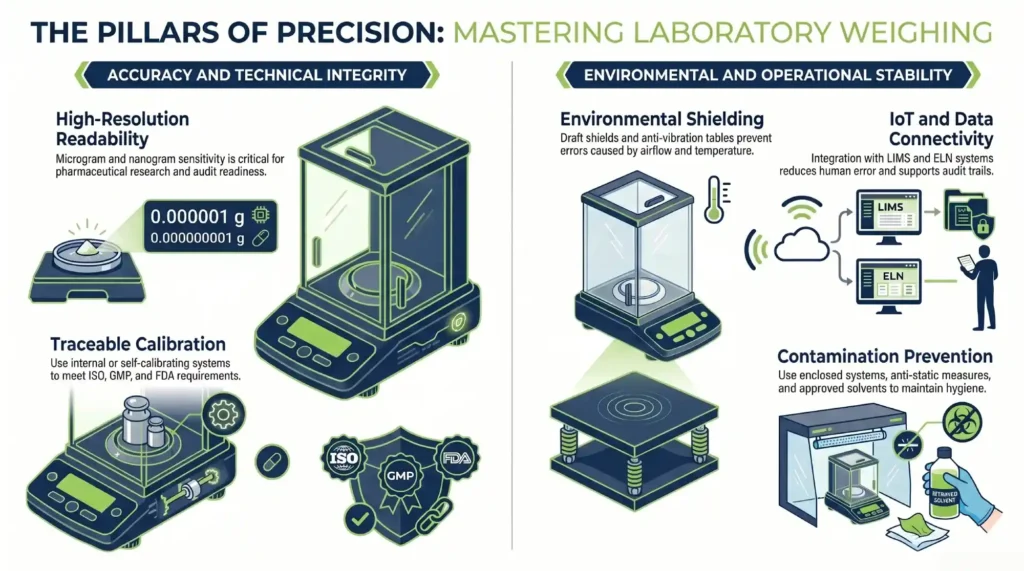
High-resolution balances provide microgram- and nanogram-level readability, critical for pharmaceutical research and QC lab operations. Precision and accuracy are directly linked to regulatory compliance and audit readiness.
Calibration and Internal Adjustment
Internal calibration, self-calibrating balances, and manual adjustment options ensure reliable traceable measurements. Calibration should follow manufacturer instructions using reference standards to meet ISO, GMP, or FDA requirements.
Draft Shields and Anti-Vibration Features
Balancing precision with environmental stability is key. Draft shields, anti-vibration tables, and controlled environments prevent erratic readings caused by air flow, temperature fluctuations, or vibrations.
Data Connectivity and Integration
Modern IoT-enabled laboratory scales and digital connectivity enable integration with LIMS, ELN, and MES systems. This reduces human error, supports audit trails, and enhances operational efficiency in high-throughput labs.
Safety, Hygiene, and Contamination Prevention
Enclosed weighing systems, glove boxes, and anti-static measures minimize cross-contamination. Cleaning protocols using soft dry cloths and approved solvents maintain laboratory hygiene and protect active ingredients from contamination.
Calibration, Traceability, and Verification Protocols
Accurate weighing in pharmaceutical labs is impossible without calibration and verification.
- Scheduled Calibration: Regular checks using traceable reference standards ensure continued precision and reliability.
- Verification Protocols: Follow SOPs for instrument qualification, Installation Qualification (IQ), Operational Qualification (OQ), and Performance Qualification (PQ).
- Traceable Measurements: All balances must maintain records linking measurements to certified standards, supporting regulatory audits.
- Documentation: Proper logs of calibration, maintenance, and verification activities support GMP and ISO compliance.
These practices help South African pharmaceutical labs maintain accuracy, reproducibility, and regulatory readiness for both research and production environments.
Contamination and Cross-Contamination Control
Preventing contamination is critical in pharmaceutical weighing:
Anti-Static Measures
Ionizers and static eliminators prevent microgram-level errors due to electrostatic charges on powders or containers.
Enclosed Weighing Systems
Draft shields, enclosed balances, and glove boxes protect sensitive compounds during weighing and reduce exposure to environmental particles.
Cleaning Protocols
Routine cleaning following manufacturer instructions and laboratory SOPs prevents cross-contamination between samples. Proper hygiene protocols maintain the integrity of tablets, capsules, and other dosage forms.
Common Challenges in Pharmaceutical Weighing
Even with the best laboratory weighing scales, pharmaceutical labs encounter challenges that can affect accuracy, precision, and regulatory compliance. Understanding these issues allows labs to implement effective solutions.
Environmental Disturbances
Factors such as vibrations, air flow, temperature changes, and humidity can influence analytical balances and precision balances. For example, placing a microbalance near HVAC vents or in high-traffic areas can cause erratic readings. Using controlled environments and anti-vibration tables mitigates these effects.
Load Cell Drift and Sensor Degradation
Over time, internal sensors in analytical and precision balances may drift, reducing accuracy. Regular calibration and following verification protocols ensure that balances maintain traceable measurements.
Operator Variability
Human error in sample preparation, handling, or reading measurements can compromise results. Training staff to use enclosed weighing systems, glove boxes, and following SOPs improves repeatability and reproducibility.
Instrument Downtime
Unexpected failures in laboratory scales can disrupt QC lab workflows or pharmaceutical production. Scheduled maintenance, proper cleaning protocols, and timely replacement of worn parts help maintain operational efficiency.
Future Trends in Pharmaceutical Laboratory Weighing
Pharmaceutical labs are increasingly adopting technology-enabled scales to improve efficiency, accuracy, and compliance.
Smart and IoT-Enabled Scales
Modern laboratory weighing scales with IoT connectivity allow integration with LIMS and MES systems, reducing transcription errors and supporting audit readiness. Digital logs provide traceable measurements for regulatory inspections.
Automated Weighing Systems
Robotic arms and sample handlers automate repetitive weighing tasks, improving high-throughput lab efficiency, reducing human error, and ensuring consistent dosage accuracy.
Sustainable and Energy-Efficient Designs
Energy-efficient balances with environmental controls reduce operational costs and environmental impact while maintaining precision in microgram- and nanogram-level measurements.
Advanced Anti-Contamination Features
Glove boxes, enclosed weighing systems, and anti-static surfaces continue to evolve, enhancing laboratory hygiene and minimizing cross-contamination risks in high-potency API handling.
Industry Use Cases
Pharmaceutical labs in South Africa rely on laboratory weighing scales across multiple workflows:
High-Potency APIs
Microbalances and analytical balances measure active ingredients in microgram or nanogram quantities, ensuring safety, efficacy, and regulatory compliance.
Compounding and Formulation Labs
Precision balances and top-loading balances support accurate mixing of excipients, binders, and disintegrants, guaranteeing uniform tablets and capsules.
Biopharmaceutical Research
Microbalances are essential for protein characterization, impurity analysis, and stability studies, providing reliable data for drug discovery and formulation validation.
Quality Control and Batch Release
Accurate weighing ensures dosage accuracy and batch uniformity, critical for production compliance with GMP, ISO, and FDA standards.
Final Thought
The role of weighing scales in pharmaceutical laboratories extends beyond simple measurement. They are critical tools for precision, quality control, formulation development, drug discovery, and regulatory compliance. Proper selection, calibration, and maintenance of analytical balances, microbalances, and precision balances ensure accuracy, reliability, and reproducibility across all pharmaceutical workflows.
For South African pharmaceutical companies and laboratories, Scales4U offers a comprehensive range of laboratory weighing scales, industrial balances, and weighing solutions. Our services include:
- Calibration and verification protocols for compliance and traceability
- Maintenance and cleaning support to prevent contamination
- High-precision balances for R&D, QC labs, and production
- Industrial weighing scales for heavy-duty applications like bulk API measurement
Investing in reliable laboratory weighing solutions ensures safe pharmaceutical production, accurate dosage forms, and confidence in every weighing task.