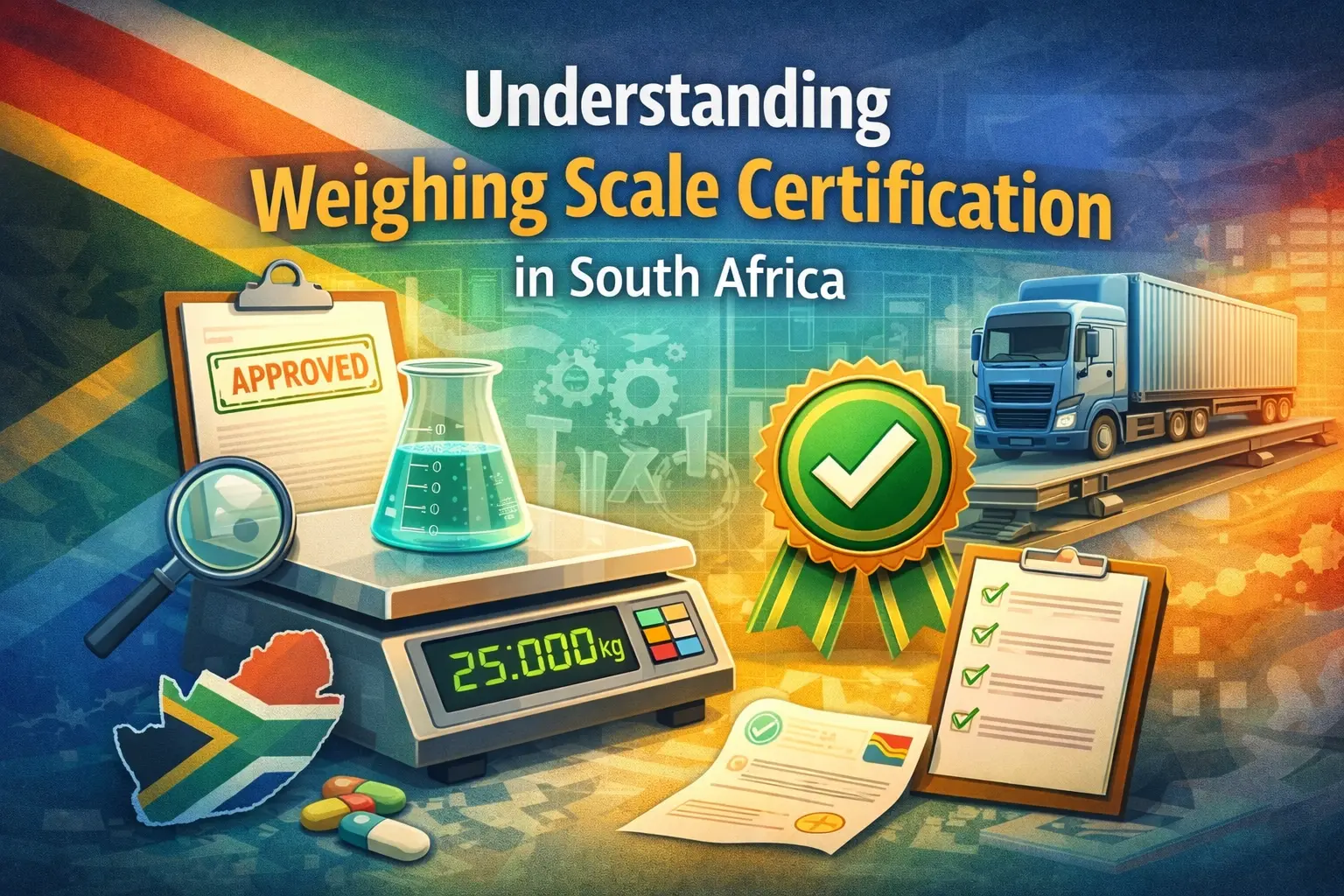
For South African businesses, selling goods by weight, whether it’s biltong at a market, bulk coal from a mine, or packaged chemicals, requires more than just having a scale that works. It demands compliance with stringent national laws. Using an uncertified, unverified, or damaged scale for trade is a direct violation of the law that can lead to large fines, confiscation of equipment, and severe legal action. This article details the essential steps for understanding weighing scale certification in South Africa, clarifying the legal requirements and ensuring your business operates with complete legal certainty and fairness.
The Legal Framework: Key Authorities and Acts
The rules governing weighing in South Africa are clear and centralized. Compliance starts with knowing the specific law and the government bodies responsible for enforcement.
The Legal Metrology Act (No. 9 of 2014)
The Legal Metrology Act is the supreme law that regulates all measuring instruments used for transactions in the country. This includes every scale that determines a price, a charge, or a duty. The Act’s main purpose is to ensure accuracy and consistency in measurements to protect both consumers from being overcharged and businesses from accidentally giving away product. It applies broadly to instruments used in trade, but also those used for health, safety, and environmental protection. For example, the scales used by doctors or the weighbridges used to enforce road safety are governed by this legislation.
The National Regulator for Compulsory Specifications (NRCS)
The NRCS is the government authority tasked with enforcing the Legal Metrology Act. The NRCS acts as the market watchdog. This body is responsible for two major functions that impact every company using scales:
- Role 1: Establishing Technical Regulations. The NRCS sets the mandatory standards (compulsory specifications) that a scale’s design must meet before it can be sold in South Africa.
- Role 2: Market Surveillance and Inspections. NRCS inspectors regularly visit businesses, factories, and transport hubs to check if scales are properly certified, sealed, and operating within the legal limits of error.
SANAS Accreditation
The South African National Accreditation System (SANAS) plays a crucial, though indirect, role in certification. SANAS does not verify scales itself; instead, it is the official body that accredits the competence of the private sector Verification Laboratories and Officers who perform the checks on behalf of the NRCS. When you choose a service provider for verification or calibration, ensuring they are SANAS-accredited is the only way to guarantee the work is performed to the highest national and international standards. A SANAS stamp means the results are traceable and technically sound.
Two Pillars of Certification: Type Approval vs. Verification
Before a scale can be used legally in South Africa, it must pass two distinct mandatory tests. Confusing these two steps is a common error that can lead to non-compliance.
Pillar 1: NRCS Type Approval (The Instrument’s Design)
Type Approval is the certification of the design and model of the weighing instrument. Before a manufacturer or importer can sell a scale model in South Africa (such as a specific model of retail scale or platform scale), they must submit a specimen to the NRCS. The NRCS tests the design to confirm it meets all technical requirements for stability, construction, and performance. Once approved, the scale model receives a Pattern Description Document, which is essentially a permanent license for that model’s design. You should only purchase scales that have already received this NRCS Type Approval.
Pillar 2: Initial and Subsequent Verification (The Installed Unit)
Verification is the inspection of the actual, physical scale unit after it has been installed at your place of business. This is the crucial step that grants the scale its “legal for trade” status.
The Inspection: A SANAS-accredited Verification Officer (VO) visits the site and tests the installed scale using certified test weights. The officer checks the scale’s accuracy and functionality, and confirms it matches the approved type design.
The Seal: After a successful verification, the VO attaches a non-removable Verification Sticker or Seal to the instrument. This seal proves the scale is compliant and prevents any unauthorized tampering or adjustments that could affect its accuracy.
The Certification Process: Step-by-Step Compliance
To maintain a compliant operation, a business must follow a clear, recurring schedule for its weighing instruments.
Step 1: Purchasing a Type-Approved Scale
The compliance process starts at the point of purchase. Always confirm with your supplier that the specific model you are buying holds the necessary NRCS Type Approval for its intended use. If a scale is not type-approved, it can never be legally verified for use in trade.
Step 2: Initial Verification and Sealing
Immediately after the scale is installed, it must undergo Initial Verification. You must contact a SANAS-accredited Verification Laboratory to schedule this inspection. The Verification Officer conducts the on-site testing and then places the physical seal on the scale. Once sealed, the scale is legally ready to be used to calculate sales and charges.
Step 3: Obtaining the Verification Certificate
Upon successful verification, the accredited laboratory will issue an official Verification Certificate. This document is your legal proof of compliance. It must be kept readily accessible for any NRCS inspector or legal authority who requests it during a routine market surveillance visit.
Step 4: Subsequent Re-Verification
The law requires that all measuring instruments used for trade must be re-verified periodically. In South Africa, this generally means re-verification is mandatory every two years. However, if a scale undergoes any major repair, is relocated (such as moving a weighbridge to a new site), or if the physical seal is broken, the scale is legally considered “unverified” and must be re-verified immediately before being put back into use.
Distinguishing Legal Requirements and Mitigating Risk
Understanding the difference between the two terms frequently used in the weighing industry, calibration and verification, is essential for legal compliance and for maintaining the operational accuracy of your equipment. Misunderstanding this distinction is a common reason for regulatory failure in South Africa.
Critical Distinctions: Calibration vs. Verification
While both procedures involve checking a scale with certified weights, their purpose, legal meaning, and results are entirely different. One is a corrective action to ensure accuracy, and the other is a legal inspection to ensure conformity with the law.
The Fundamental Difference
Calibration is a technical process where a technician uses known weights to compare against the scale’s reading, determines the degree of error, and then adjusts the scale’s internal settings to minimize that error. Calibration is done to improve the scale’s performance and maintain its accuracy. Verification, on the other hand, is a purely legal inspection required by the NRCS under the Legal Metrology Act. The Verification Officer checks if the scale is performing within the maximum permissible error (MPE) allowed by law, and if it passes, they certify it as “Legal for Trade.” The officer verifies compliance; they do not typically adjust the scale’s internal settings unless they are also accredited to provide repair services.
The Dual Necessity
Your business needs both. Verification is necessary to avoid fines and stay compliant with the law, while Calibration is necessary to prevent stock loss and protect your profit margin (by ensuring your customers are accurately charged and you are not giving away product). For example, a scale can be legally verified but still slightly off enough to cause significant financial loss through consistent over-weighing. This is why regular technical adjustments, or calibration services, should be scheduled between the mandatory two-year verification cycles.
| Procedure | Purpose | Performed By | Frequency | Legal Outcome |
| Verification | Confirms compliance with the Legal Metrology Act. | SANAS-Accredited Verification Officer (VO). | Every 2 years or after repair. | Legal for Trade Status. |
| Calibration | Corrects the scale’s internal accuracy to reduce errors. | SANAS-Accredited Calibration Technician. | As needed, or annually. | Accurate Readings and Profit Protection. |
The Cost of Non-Compliance and Risk Mitigation
Failing to meet the legal requirements for your weighing instruments can result in severe financial and reputational damage. The cost of certification is always significantly lower than the cost of failure.
Direct Penalties (Fines and Confiscation)
If an NRCS market surveillance inspector finds a scale being used for trade without the official Verification Sticker/Seal, the inspector has the power to issue immediate fines and demand that the instrument be immediately removed from service. In serious cases, the goods sold using the unverified scale may be seized, and the equipment itself may be confiscated. For large industrial scales, such as weighbridges, the fines can be substantial, resulting in costly operational downtime until the scale is re-verified.
Operational Risk and Suspension of Trade
Beyond fines, non-compliance poses a major threat to your trade continuity. If your primary counter scale or floor scale is deemed illegal, your business may be forced to suspend sales that depend on weight until the matter is resolved. This can bring production or dispatch processes to a sudden stop. Furthermore, any disputes with customers or competitors over bulk sales become indefensible without the mandatory Verification Certificate to back up the recorded weights.
Reputational Damage and Loss of Trust
Compliance is a matter of business integrity. If it becomes publicly known that your company was fined for using inaccurate or uncertified scales, it leads to a devastating loss of consumer confidence. This is especially true in sensitive industries like food processing, pharmaceuticals, or logistics, where weight directly translates to value or safety. Understanding weighing scale certification in South Africa is therefore fundamental to maintaining a trustworthy brand image in the marketplace.
The Importance of Record Keeping
To successfully mitigate risk, a business must maintain a comprehensive documentation trail. This paper trail is evidence of due diligence. You must keep:
- The NRCS Type Approval document (or confirmation from the supplier).
- The current Verification Certificate.
- All previous calibration and repair logs.
- The date of the next required re-verification.
Having this information organized and readily available saves time and prevents heavy penalties during an inspection.
Frequently Asked Question
Who is legally allowed to verify weighing scales in South Africa?
Verification can only be performed by a SANAS-accredited Verification Officer (VO) who is employed by a designated Verification Laboratory. Individuals and businesses cannot legally perform the verification process themselves. Always ask for proof of SANAS accreditation before commissioning verification services.
How often do industrial scales need to be certified in South Africa?
Industrial scales, including weighbridges and floor scales used for trade, must undergo subsequent re-verification at intervals not exceeding two years. If the scale is repaired, relocated, or if the official seal is broken at any time, it must be re-verified immediately before being put back into use.
What is the minimum documentation I must keep for my trade scale?
The single most important document is the current Verification Certificate, which proves your scale passed the required legal inspection. You must also maintain a record of all repair logs, previous calibration certificates, and the date of the scale’s original Type Approval (which should be verifiable via the supplier).
What does ‘Type Approved’ mean in relation to the NRCS?
Type Approved means that the design or model of the weighing instrument has been tested by the NRCS and found to conform to all compulsory technical and quality standards specified in South African law. A scale without Type Approval cannot legally receive Verification.
Conclusion
For South African businesses, understanding weighing scale certification in South Africa is not an administrative burden; it is a mandatory commercial safeguard. Proper certification shields your company from severe NRCS fines and confiscation, protects your profit by ensuring you never over-dispense product, and builds consumer trust in your trade practices.
The successful management of weighing compliance depends on two things: using Type Approved equipment and maintaining a strict schedule of Verification and calibration with a qualified partner. Do not wait for an NRCS inspector to find a broken seal or an expired certificate.
Is your scale’s certification current? Protect your business from severe NRCS fines and ensure every transaction is legally sound. Partner with South Africa’s leading authority. Contact Scales4U today for SANAS-accredited verification, expert repair, and a guaranteed path to legal compliance for all your industrial and retail weighing instruments.