
Choosing the right weighing scale for your business is more than just a practical decision. It directly impacts your operational efficiency, customer experience, and overall productivity. Whether you’re running a retail store, a manufacturing plant, or a healthcare facility, using the wrong type of weighing scale can lead to inaccurate measurements, compliance issues, and even operational delays.
In this guide, we’ll explore how to choose the right scale for your business, focusing on factors like capacity, accuracy, environment, and your specific industry needs. If you’re based in South Africa, this guide is tailored for you, with insights on local suppliers, compliance standards, and tips to help you make an informed decision. From retail to industrial, medical to laboratory scales, we’ll cover it all to ensure that your investment in weighing equipment is a step toward greater efficiency and growth.
Understanding Your Business’s Weighing Requirements
Before you make any decisions about which weighing scale to purchase, it’s essential to understand the specific requirements of your business. Weighing equipment comes in a wide variety of models, each suited to a particular task or industry. By clarifying your business’s unique needs, you can avoid unnecessary costs and ensure that you select a scale that truly serves your operations.
1. Capacity and Accuracy
When selecting a scale, the most important factors to consider are capacity and accuracy. Capacity refers to the maximum weight the scale can measure, while accuracy determines how precise the scale’s measurement is. For example, a retail store selling produce will need a scale that can handle moderate weight, whereas a laboratory needs scales that measure with a high degree of precision (milligrams or grams).
- For large quantities of goods, industrial scales (like floor scales or weighbridges) are ideal because they can handle heavier loads.
- For sensitive operations like medical scales (for babies, bariatrics, or precise patient measurements), you need high accuracy to ensure measurements are precise.
2. Environment and Durability
Consider the environment where your scale will be used. Will it be exposed to moisture, dust, or chemicals? Will it need to withstand heavy usage? Scales used in industrial and warehouse settings, for instance, must be durable and rugged, with features like stainless steel platforms and overload protection to handle tough conditions.
For example:
- Retail environments may benefit from lightweight POS scales with easy-to-read displays.
- Production facilities may require industrial scales with heavy-duty components that can withstand continuous use.
3. Regulatory Compliance
For businesses that deal with products sold by weight, like supermarkets, food producers, or shipping companies, ensuring that your scale meets trade-approved standards and legal metrology regulations is critical. In South Africa, scales used for commercial transactions must comply with local weights and measures regulations, ensuring accurate readings for both consumers and businesses.
Regulatory Compliance: Meeting South African Standards
South Africa has specific legal metrology standards that commercial scales must meet to ensure accurate and trustworthy transactions. This means that if you’re selling by weight, your business needs to use trade-approved scales that are certified for accuracy and compliance.
Some key elements of compliance include:
- Verification: Weighing scales must be verified and approved by local regulatory bodies.
- Calibration: Regular calibration ensures the scale remains accurate over time.
- Certification: Certain scales, especially those used in retail, need certification to ensure they meet legal metrology standards for trade.
If you’re unsure about whether your scales meet these requirements, consulting a local scale supplier like Scales4U can help. They offer expert services, including scale calibration and verification to ensure your equipment is compliant and ready for use.
Types of Weighing Scales for Different Business Sectors
Different types of weighing scales available for businesses. Depending on your industry, the right scale type will vary. Understanding these differences will help you choose the equipment that best suits your needs.
Retail Scales: Reliable Solutions for Shops and Supermarkets
Retail scales are essential for businesses that sell products by weight, such as supermarkets, butcheries, or farm stalls. These scales must be quick, easy to use, and able to withstand frequent customer interaction. Here’s what to look for:
- POS Scales: These scales integrate seamlessly with point-of-sale (POS) systems to calculate and print product prices. They often come with label printing capabilities for easy product tracking.
- Label Printing Scales: These scales can print product labels with weight and pricing information, making them ideal for supermarkets and markets.
- Compact and Easy-to-Use: Retail scales are typically smaller and more compact for easy installation in counters or checkout areas.
Industrial Scales: Heavy Duty for Manufacturing, Warehouses, and Production Environments
Industrial environments require robust and heavy-duty scales. Whether you’re managing inventory in a warehouse or weighing materials in a factory, your industrial scales must be capable of handling large weights and rough conditions.
Types of Industrial Scales:
- Platform Scales: These large, flat surfaces allow for the easy weighing of heavy items like pallets or bulk materials.
- Weighbridges: Essential for weighing large vehicles, like trucks or containers, that need to be weighed when loaded.
- Floor Scales: These are designed to be placed directly on the ground and can handle heavy loads, making them ideal for warehouses or shipping areas.
Laboratory Scales: Precision for Scientific Accuracy
Laboratory scales are used in scientific and research environments where precise measurements are critical. When absolute precision is required, understanding the functional differences between digital and mechanical laboratory scales can help you decide which technology provides the stability and readability your research demands. These scales must offer high accuracy to measure even small amounts of materials with extreme precision.
Types of Laboratory Scales:
- Analytical Balances: These are the most accurate scales, used in labs for precise measurements (typically to the nearest milligram or gram).
- Precision Balances: Slightly less sensitive than analytical balances but still highly accurate for scientific work.
Medical and Healthcare Scales: Ensuring Accuracy for Patient Monitoring
In medical environments, accuracy is crucial for patient care. Medical scales are used for monitoring weight in hospitals, clinics, and healthcare facilities. These scales must also be compliant with health standards.
Types of Medical Scales:
- Baby Scales: Used to weigh infants and young children accurately.
- Bariatric Scales: Designed for weighing obese patients, these scales have higher weight capacities.
- Wheelchair Scales: These are used to weigh patients who are unable to stand on regular scales.
Counting and Inventory Scales: Simplifying Bulk Item Counting
For businesses dealing with large quantities of small items, counting scales are indispensable. These scales simplify inventory management by allowing you to count bulk items quickly and efficiently.
Types of Counting Scales:
- Digital Counting Scales: These scales can quickly count items based on weight, which is particularly useful in warehouse operations and inventory management.
- Inventory Weighing Systems: Ideal for managing and tracking bulk goods or packaged items in warehouses.
Key Considerations for Choosing the Right Scale
When choosing the right weighing scale for your business, it’s not just about selecting the correct type, it’s also crucial to evaluate key features, costs, and long-term support needs. A good weighing scale is an investment that should provide value and reliability for years to come.
Budgeting for Your Weighing Scale
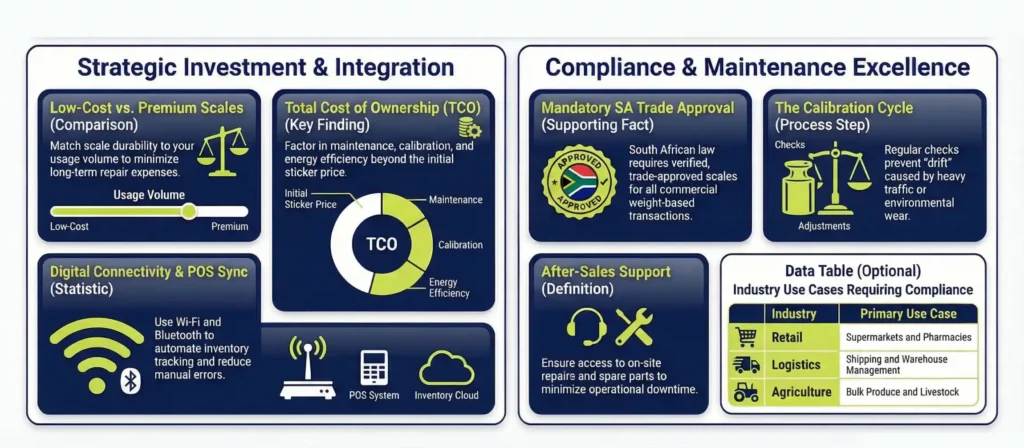
Choosing a scale is often a balance between cost and long-term value. The initial price might be important, but it’s equally crucial to consider the total cost of ownership over time, including maintenance, calibration, and the potential for upgrades or replacements. For short-term projects or annual stocktakes, hiring weighing scales is often a more financially sound strategy than purchasing specialised equipment that may sit idle for most of the year.
Initial Cost vs. Long-Term Investment
While a lower initial cost may seem appealing, it’s crucial to consider long-term expenses. Cheaper scales often require frequent repairs, calibration, and eventual replacements, leading to higher maintenance costs. Energy efficiency and service contracts can also impact the total cost, making it essential to weigh both upfront and ongoing expenses when selecting a scale.
Choosing Between Low-Cost and Premium Scales
Low-cost scales are ideal for businesses with lighter usage or less demanding environments but may lack advanced features, leading to higher maintenance. Premium scales, on the other hand, are designed for high-volume operations, offering better durability, precision, and longevity, making them a more cost-effective investment for businesses with more rigorous needs.
Understanding Calibration and Maintenance Needs
To keep your weighing scales operating at their best, you must factor in calibration and maintenance. Even the most advanced scales need regular checks to ensure they are functioning properly and providing accurate measurements.
1. Importance of Calibration
Calibration is essential to maintain the accuracy of your scale’s readings. With regular use, scales can drift due to wear, environmental conditions, or heasvy traffic. For businesses like retail stores and logistics companies, frequent calibration ensures that pricing and operations remain precise. In South Africa, calibration is not just an operational need but a legal requirement for businesses dealing with products sold by weight.
2. Choosing a Service Provider for Maintenance and Calibration
When selecting a service provider, ensure they offer comprehensive maintenance, calibration, and repair services. A reputable supplier, such as Scales4U, will provide routine check-ups, rapid repair response times, and calibration certification that ensures compliance with local metrology standards and regulatory requirements.
3. Importance of After-Sales Support
After-sales support is critical for keeping your scale in peak condition. A solid service package can minimize downtime and prevent unexpected costs. Look for providers who offer on-site repairs, access to spare parts, technical assistance, and warranty guarantees to ensure long-term reliability and peace of mind.
Connectivity and Integration with Business Systems
In today’s fast-paced business world, it’s not enough to just have a scale that weighs products; your scale should be able to seamlessly integrate with your existing business systems. If your business involves selling goods by weight, using trade-approved weighing scales in South Africa is a mandatory legal requirement to protect both your revenue and your customers from measurement errors. Whether you are running a retail store or a warehouse, connectivity can help automate processes and improve accuracy.
1. Digital Connectivity
Many modern scales offer digital connectivity, including Wi-Fi, Bluetooth, and USB ports, allowing you to:
- Sync data directly with your point-of-sale (POS) system or inventory management software.
- Monitor weights and track sales automatically in real-time.
- Generate reports for business analysis and compliance.
For example:
- Retail POS scales often connect to the store’s inventory and pricing system, enabling real-time inventory updates.
- Industrial scales can be connected to manufacturing systems for automated stock tracking and production management.
2. Software Integration
Some scales come with their own software for monitoring and reporting, but others integrate with third-party software, such as inventory management systems or ERP (Enterprise Resource Planning) software. The ability to track weighing data digitally can reduce errors and help manage operations more efficiently.
Ensuring Compliance with Local Standards
In South Africa, using trade-approved scales that comply with legal metrology standards is not just a good practice; it’s mandatory for businesses involved in commercial transactions based on weight. These regulations ensure that customers receive fair value for the products they purchase and that businesses can avoid costly fines or penalties.
1. Trade-Approved Scales
When selling by weight, your scale must meet trade approval standards to ensure it’s accurate and reliable for transactions. Non-compliant scales can lead to disputes, fines, or even the closure of your business.
- Verification: South African businesses must have their scales verified by a legal metrology service provider to ensure compliance.
- Certification: Once verified, your scale will be issued a certificate of approval.
2. Adhering to Weights and Measures Regulations
Compliance with weights and measures regulations is vital in industries such as retail (supermarkets, pharmacies), logistics, agriculture, and manufacturing. It’s essential to work with certified suppliers and services that help you meet these regulations.
Choosing a Service Provider for Weighing Scales
A reliable supplier not only sells you a scale but also provides ongoing support, ensuring your scale remains accurate and operational. Scales4U offers a range of weighing solutions with expert advice, calibration services, and comprehensive support.
Whether you need retail scales, industrial solutions, or medical equipment, choosing a reputable provider like Scales4U guarantees that your investment is backed by excellent service and compliance with South African standards.
- Expert Consultation: Work with industry specialists to choose the right scale for your needs.
- Maintenance Packages: Choose a service provider that offers reliable maintenance contracts and calibration services.
- After-Sales Support: Ensure quick access to technical support and repairs if necessary.
Final Thought
Choosing the right weighing scale for your business involves understanding your specific needs, from the capacity and accuracy required to the environment in which the scale will be used. Whether you’re in retail, industry, healthcare, or any other sector, it’s important to consider budget, long-term maintenance, and compliance with local regulations. By selecting the right scale, you can ensure more accurate measurements, improve your business efficiency, and avoid compliance issues.
At Scales4U, we provide trade-approved scales that meet legal metrology standards and offer a range of services from installation to maintenance. If you’re unsure about which scale suits your business, contact us for expert advice. Our team is here to help you make the right choice for your needs.