
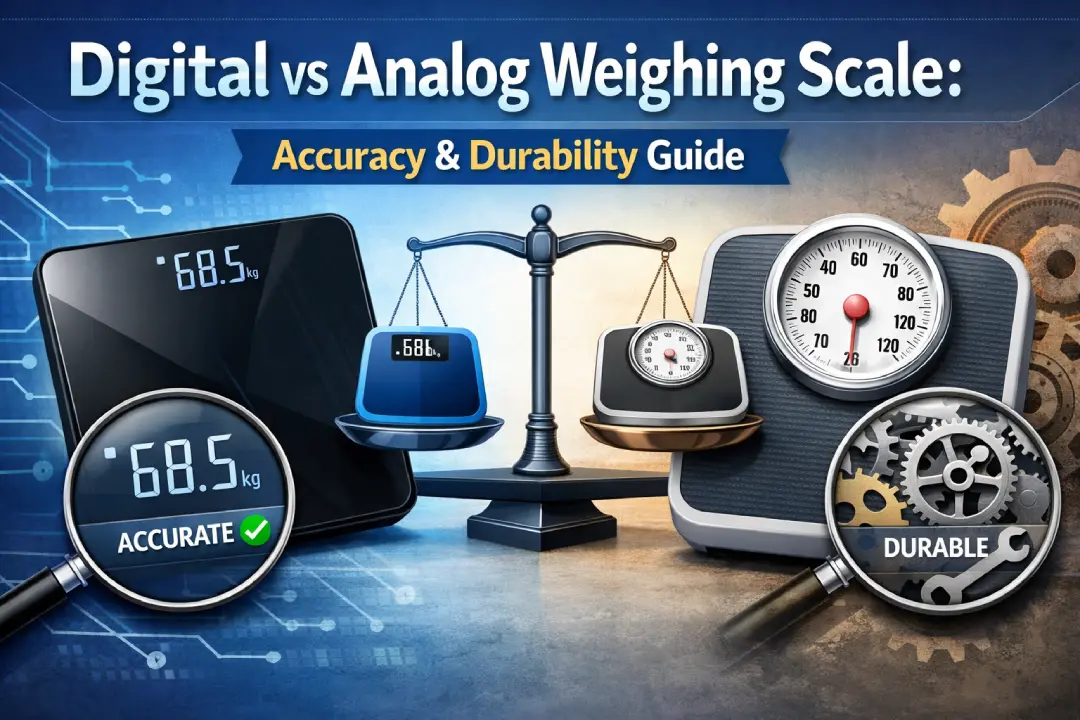
Choosing the right weighing equipment is often a trade-off between long-term durability and day-to-day precision. Many South African business owners and homeowners find themselves frustrated when two different scales give two different readings, leading to doubts about which one to trust for health tracking or commercial trade. Whether you are running a busy retail shop in Johannesburg or monitoring your fitness progress at home, understanding the core differences between digital and analog technology is the first step to ensuring your data is accurate and your investment lasts. At Scales4U, we see firsthand how the wrong choice can lead to compliance issues or simple daily annoyances, which is why we have broken down everything you need to know about these two distinct weighing methods.
What is a Digital Weighing Scale?
A digital weighing scale is a modern electronic device that uses high-precision sensors to measure weight. Unlike older models, these units rely on a component called a load cell. When you place an item on the scale, the load cell bends slightly under the pressure. This mechanical change is converted into an electrical signal. A small internal computer, or microprocessor, then calculates that signal and displays the result as a clear number on an LCD or LED screen. Because they use electronic pulses rather than physical moving parts to show the final result, digital scales can provide extremely specific readings, often down to two or more decimal places.
What is an Analog Weighing Scale?
Analog scales, often called mechanical scales, are the traditional choice that has been used for decades. These devices operate on a purely physical system, usually involving a set of internal springs and levers. When weight is applied to the platform, it compresses a large spring. This movement is linked to a gear system that physically turns a needle or a circular dial to point at a specific number. There are no batteries, circuit boards, or screens involved. While they are prized for their simplicity, they require the user to look closely at where the needle lands on a printed line, which leaves more room for human interpretation.
Digital vs. Analog Scales
When deciding between these two, it helps to see how they stack up across the most important categories. In the South African market, where both industrial and home use vary wildly, these differences are key to your purchasing decision.
| Feature | Digital Scales | Analog Scales |
| Measurement Tech | Electronic Load Cells | Mechanical Springs |
| Power Needs | Batteries or Plug-in | No Power Required |
| Ease of Reading | Instant Numbers on Screen | Needle on a Printed Dial |
| Precision | Very High (e.g., 0.01kg) | Moderate (e.g., 0.5kg) |
| Additional Data | BMI, Memory, Unit Switching | Weight Only |
| Maintenance | Low (Auto-Zeroing) | Higher (Manual Calibration) |
The Accuracy Showdown: Why Digital Usually Wins
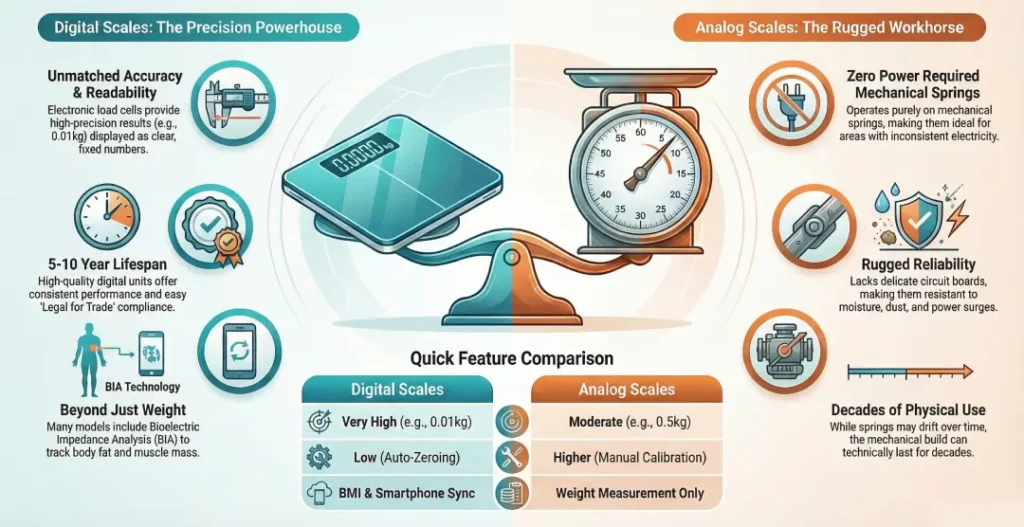
In the battle for accuracy, digital scales almost always come out on top due to how they handle data. One of the biggest problems with analog scales is something called parallax error. This happens when two different people look at the needle from different angles and see different weights. Digital scales remove this issue entirely by showing a fixed number on a screen. Furthermore, mechanical springs are subject to metal fatigue. Over years of use in a warehouse or bathroom, a spring loses its snap and fails to return to its original shape. If you suspect your readings are drifting, there are several simple ways to know if your weighing scale is correct before calling in a professional. This causes the scale to drift, leading to results that get more and more inaccurate over time. Digital load cells, while sensitive, do not suffer from this specific type of mechanical wear, making them much more consistent for long-term use.
Beyond Just Weight: The Rise of Smart Digital Scales
Modern weighing technology has progressed far beyond simply telling you how many kilograms you weigh. Digital scales now often include Bioelectric Impedance Analysis (BIA), which sends a small, safe electrical current through your feet to estimate body composition. This allows users to track metrics like body fat percentage, muscle mass, and even bone density.
Scientific and pharmaceutical environments require a higher level of sensitivity, often necessitating the use of precision laboratory balances for milligram-perfect results. For those pursuing active lifestyles or medical-supervised weight loss, these smart features provide a much clearer picture of health than a single number. Many of these units can sync directly to your smartphone via Bluetooth, allowing for long-term data logging without the need for a manual notebook.
Durability & Reliability: The Case for Analog
While digital scales are high-tech, analog scales remain the kings of rugged reliability. In environments where electronics often fail, such as high-moisture greenhouses, dusty workshops, or remote farming areas, a mechanical scale is often the only tool that keeps working. Because they have no delicate circuit boards or LCD screens, they are much less likely to be damaged by static discharge, power surges, or light splashes of water. For many South African businesses operating in areas where electricity is inconsistent, the fact that an analog scale requires zero batteries or charging is a massive operational advantage.
Lifespan and Build Quality: What to Expect
The lifespan of your scale depends largely on its internal components and how well you look after it. A high-quality digital scale, like those found in the Micro range at Scales4U, is built to last between 5 and 10 years with regular battery changes and careful use. On the other hand, a well-built analog scale can technically function for decades because its parts are purely mechanical. However, it is a myth that analog scales stay accurate forever. Over time, the internal springs can stretch or rust, especially in humid coastal climates like Durban or Cape Town. Digital scales tend to stay consistent until a sensor fails, while analog scales slowly drift over the years, requiring more frequent manual checks.
Calibration and Compliance: Ensuring Legal for Trade Status
In South Africa, if you are selling goods by weight, whether it’s meat in a butchery or produced at a market, your scale must be Legal for Trade. This means it needs to be verified by the National Regulator for Compulsory Specifications (NRCS). Digital scales are generally easier to keep compliant because they often feature auto-zeroing and digital calibration modes that ensure the sensor is perfectly balanced every time it turns on. Analog scales require the user to manually turn a small knob to zero the needle before every single use. If this step is forgotten, every measurement taken afterward will be wrong, which can lead to financial losses for a business or legal issues during a weights-and-measures audit. In the commercial sector, ensuring fair trade is vital, which is why choosing a ‘Legal for Trade’ retail scale is essential for any grocery or deli business.
Cost Analysis: Short-term vs. Long-term Value
When comparing the price of digital and analog scales, it is important to look past the initial sticker price. Generally, basic analog scales are more budget-friendly upfront, often retailing for significantly less than their digital counterparts. However, digital scales, such as the popular WS30 digital weigher, provide a different kind of value through efficiency. While a digital unit may require an investment in batteries or a steady power connection, it saves money by preventing over-filling in commercial settings due to its high precision. At Scales4U, we often remind clients to consider the Total Cost of Ownership, which includes potential repair costs, the price of battery replacements, and the time spent on manual calibration for older mechanical models.
Conclusion: Which Scale is Right for You?
The choice between digital and analog ultimately depends on your specific environment and how much room for error you can afford. If you are looking for a rugged, battery-free solution for a warehouse or a farm where electricity is a luxury, an analog scale is a dependable workhorse that will last for years. However, for almost every other application, from medical clinics and retail shops to home fitness, digital scales are the superior choice. They offer unmatched readability, instant results, and the ability to track data that mechanical scales simply cannot capture. For South African businesses, the added benefit of easy NRCS compliance makes digital the standard for modern trade.
Frequently Asked Questions
What makes digital scales more accurate than analog scales?
Digital scales use electronic load cells that can detect minute changes in weight, often down to 1 gram or less. Analog scales rely on springs that can lose tension over time and are prone to parallax error, where the reading changes based on the angle at which you view the needle.
How often should I calibrate my scale?
For home use, calibrating once every few months is usually enough. However, for South African businesses, legal-for-trade scales used in commercial transactions must be verified at least once every two years by a SANAS-accredited laboratory to stay compliant with national regulations.
Can analog scales measure small weight changes?
Most standard analog scales have a limited readability, often only showing increments of 500g or 1kg. If you need to measure small changes, such as for baking or medical monitoring, a digital scale is necessary as it can show weight in much smaller, more precise increments.
Do digital scales require special care?
Yes. Unlike mechanical scales, digital units have sensitive circuit boards. You should keep them away from extreme moisture, avoid dropping heavy items onto the platform (shock loading), and ensure batteries are replaced regularly to prevent acid leaks from damaging the electronics.
Which scale lasts longer, digital or analog?
If durability is the only factor, analog scales generally have a longer physical lifespan because they lack electronic parts that can burn out. However, a high-quality digital scale from a reputable brand like Micro can easily last 10 years or more with proper care and regular servicing.