

When working in a laboratory, precise measurements are crucial to obtaining reliable results. Whether you’re conducting experiments, performing quality control, or analyzing substances, the accuracy of your scales plays a significant role in maintaining data integrity. Calibration is a key component of ensuring your scales remain accurate. However, one common challenge labs face is deciding between internal and external scale calibration.
We will tell you the differences between internal and external calibration, guide you through the best method for your laboratory, and explain how Scales4U can help ensure your scales remain compliant and precise. Choosing the right calibration method is critical to maintaining the quality of your work, meeting regulatory standards, and avoiding costly errors.
What is Scale Calibration and Why is It Crucial for Laboratories?
Scale calibration is the process of adjusting a scale to ensure that its readings are accurate and match a known reference weight. It’s essential for any laboratory, as even slight errors in measurements can lead to inaccurate results, which in turn can affect the reliability of experiments or products. Calibration can be done either internally or externally, depending on the scale’s design and the level of precision required.
Why Calibration is Important for Laboratories
Calibration is crucial for a number of reasons:
- Accuracy: Scales need to be accurate to ensure that measurements are correct, particularly in scientific research, manufacturing, and pharmaceutical testing. Without accurate calibration, results could be compromised.
- Regulatory Compliance: Laboratories must comply with strict regulations, such as ISO and FDA standards, which require regular calibration and traceable results.
- Data Integrity: In research and product testing, even small inaccuracies can lead to incorrect conclusions or faulty products, which can have serious consequences.
- Equipment Longevity: Regular calibration helps maintain the performance of your scale over time, ensuring that it lasts longer and continues to function at peak efficiency.
By maintaining accurate calibration practices, laboratories can avoid issues such as incorrect data, failed regulatory audits, and premature equipment breakdowns.
What is Internal Calibration?
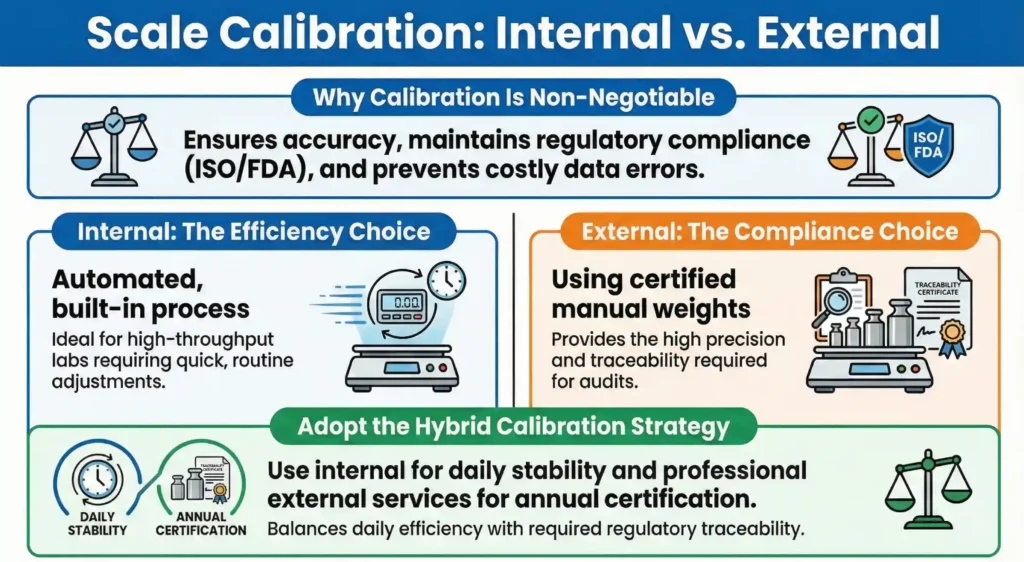
Internal calibration is the process in which a scale uses built-in mechanisms (often motorized weights or software triggers) to automatically adjust the readings of the scale. This process is typically automated and does not require the use of external calibration weights. The calibration can be triggered by pre-set time intervals, changes in temperature, or other environmental factors.
For labs with fluctuating environments, digital weighing technology in agriculture and high-precision research, internal calibration is a lifesaver. It accounts for “drift” without requiring a technician to stop their work. Our Laboratory Scales often feature these motorized systems for seamless accuracy.
How Internal Calibration Works
Internal calibration relies on the scale’s built-in sensors and mechanisms. When the scale detects a change in environmental conditions (such as temperature or power fluctuations), it automatically adjusts itself to maintain accurate readings. Some advanced scales may also have auto-calibration features that can detect when recalibration is needed, ensuring that the scale remains accurate without manual intervention.
Pros of Internal Calibration
- Convenient: Internal calibration is often automated, reducing the need for user intervention. Calibration can be done without external equipment, which is particularly useful in high-throughput labs.
- Time-Efficient: Internal calibration is quick and often happens in the background, allowing your scale to be calibrated with minimal downtime.
- Low Maintenance: Once set up, scales with internal calibration require fewer external services and are suitable for everyday use.
- Ideal for Routine Use: It is especially effective in labs where the scale is used frequently and requires regular calibration without disrupting workflow.
Cons of Internal Calibration
- Higher Cost: Scales with internal calibration mechanisms are typically more expensive due to the advanced technology required.
- Less Traceable: Because internal calibration doesn’t rely on certified external weights, it can be less suitable for regulatory or audit requirements where full traceability is needed.
- Limited Precision: While internal calibration works well for general use, it may not be as precise as external calibration, especially in labs that require the highest level of accuracy.
Best Use Cases for Internal Calibration
Internal calibration is ideal for labs where speed, efficiency, and high-volume measurements are required. It’s especially suited for applications where the precision is important but not to the degree needed for highly regulated industries such as pharmaceuticals or food testing.
What is External Calibration?
External calibration involves manually adjusting the scale using certified calibration weights that are placed on the scale’s platform. This method typically requires a professional or operator to perform the calibration by comparing the scale’s readings to a known standard. Even if your scale has internal features, you still need to know how to calibrate your scale externally to verify that the internal mechanism hasn’t failed or become contaminated.
How External Calibration Works
During external calibration, the operator will place certified calibration weights on the scale and compare the displayed weight to the known value. If there is a discrepancy, the scale is adjusted manually to match the reference standard. This process ensures that the scale is accurately calibrated and in compliance with regulatory standards.
Pros of External Calibration
- Higher Accuracy: External calibration generally provides more precise and reliable results, which is why it’s preferred in environments where extreme accuracy is essential.
- Regulatory Compliance: Many industries, particularly those that handle sensitive data or products, require external calibration to ensure traceability and compliance with industry standards such as ISO or FDA regulations.
- Full System Verification: External calibration not only verifies the scale’s readings but also checks the internal mechanisms, ensuring the scale is operating properly across all components.
Cons of External Calibration
- Time-Consuming: External calibration takes longer than internal calibration since it involves manual adjustments and the use of certified weights.
- Costly: It can be expensive, as it requires professional calibration services and the purchase and maintenance of certified weights.
- User Error: Manual calibration can introduce human error, especially if weights are not handled correctly or the procedure is not followed properly.
Best Use Cases for External Calibration
External calibration is best suited for laboratories in regulated industries where precision and traceability are critical, such as pharmaceutical research, food testing, or quality control. It is also ideal for labs that deal with highly sensitive measurements and require certification for regulatory purposes.
Key Differences Between Internal and External Calibration
Here’s the key differences between internal and external calibration:
| Factor | Internal Calibration | External Calibration |
| Ease of Use | Convenient, often automated | Requires manual handling and more time |
| Cost | Generally cheaper | More expensive due to professional services and certified weights |
| Accuracy | Adequate for general use, less precise | Higher accuracy, suitable for sensitive applications |
| Traceability | Less traceable, not ideal for audits | Fully traceable, ideal for compliance |
| Maintenance | Low maintenance, automatic | Requires regular manual calibration and certified weights |
| Ideal for | Routine tasks, high-volume labs | Highly regulated labs requiring precision and audits |
When to Choose Internal Calibration
- Ideal for labs that need quick, routine calibrations with minimal downtime.
- Suitable for high-throughput labs where convenience and speed are more important than absolute precision.
When to Choose External Calibration
- Necessary for labs that require higher precision and traceability for regulatory compliance.
- Best for regulated environments (e.g., pharmaceutical, food testing) where audit trails and certifications are required.
For many labs, the best approach is a hybrid one: using internal calibration for daily stability and a professional Calibration Service for annual certification.
Best Practices for Scale Calibration in Laboratories
Ensuring your scale remains accurate through proper calibration requires more than just selecting the right method. Following best practices for calibration is essential to guarantee long-term performance and compliance with industry standards. Whether you’re using internal or external calibration, the following tips will help you maintain the reliability and accuracy of your scale.
1. Set a Regular Calibration Schedule
Calibration should not be a one-time task. Scales in laboratories are exposed to various factors like temperature changes, vibrations, and even everyday wear and tear. To ensure that scales continue to perform accurately, it’s important to calibrate them regularly.
- For internal calibration, scales that use automatic recalibration can perform adjustments on a scheduled basis, but it’s still important to monitor the frequency of these adjustments and manually verify them periodically.
- For external calibration, establish a routine where calibration is done at regular intervals, depending on the frequency of use and precision required. For highly regulated labs, calibrating every 6 months to 1 year is common practice.
Regular calibration ensures that your scale maintains accurate readings over time, helping prevent issues that can arise from drift or calibration inaccuracies.
2. Use Certified Weights for Calibration
When performing external calibration, always use certified weights that meet national or international standards (such as OIML or ASTM standards). Certified weights are tested against known reference standards, making them ideal for achieving reliable calibration.
- For internal calibration, although no certified weights are used, it’s still important to ensure that the internal mechanisms are accurate and functioning properly, as discrepancies can arise if not maintained correctly.
Using certified weights ensures your calibration is traceable and reliable, especially when regulatory compliance is a concern.
3. Ensure a Stable Calibration Environment
Environmental factors, such as temperature, humidity, and vibrations, can significantly affect scale calibration. For the most accurate results, always perform calibration in a stable, vibration-free environment.
- Temperature: Scales should be calibrated in a temperature-controlled room to avoid fluctuations that could impact readings. If temperature changes are frequent, consider scales with temperature compensation features.
- Vibrations: Use vibration-isolating pads or place scales on stable surfaces to minimize any external forces that may alter readings.
- Humidity: Excessive humidity can damage the internal components of a scale or affect the calibration accuracy. Ensure the environment is not too humid or too dry.
By controlling these environmental variables, you can significantly improve the accuracy of your calibration process, whether internal or external. Always ensure your Laboratory Balances are on a dedicated anti-vibration table.
4. Document Calibration Procedures and Results
Maintaining thorough records of each calibration procedure is essential for compliance and quality control. Documentation should include:
- The date and time of calibration.
- Weights used, including the type and certification information.
- The calibration results, including the discrepancy between the scale’s reading and the reference weight.
- Operator information, especially for external calibrations that require manual intervention.
- Any adjustments made during the process.
Proper documentation ensures that your calibration process is traceable and compliant with industry standards, making audits and regulatory checks much easier to manage.
5. Perform Calibration Post-Maintenance
Whenever a scale undergoes maintenance (e.g., cleaning, repair, or transport), it’s crucial to perform a calibration check afterward to ensure that the scale is still functioning correctly.
- If the scale was moved or exposed to vibrations, recalibration might be necessary to confirm its accuracy.
- After cleaning, make sure all components are correctly aligned, and recalibrate the scale to confirm that the internal mechanisms are undisturbed.
This ensures that any disruptions caused during maintenance do not affect the scale’s performance, and it continues to provide accurate and reliable results.
How Scales4U Can Help with Calibration Services
At Scales4U, we understand how important scale accuracy is for laboratories. Our professional calibration services are designed to ensure your laboratory scales maintain compliance and accuracy over time. Whether you need internal calibration for routine use or external calibration for regulatory compliance, we have the right solution for your needs.
Why Choose Scales4U for Calibration?
- Certified Experts: Our team consists of trained professionals who perform both internal and external calibration services with precision and care. We ensure all calibrations are traceable and compliant with industry standards.
- High-Precision Scales: We provide a wide variety of scales that meet the needs of laboratories requiring high accuracy. Whether you need digital balances for regular use or high-precision analytical balances, we offer scales that fit your requirements.
- Regular Maintenance and Support: Beyond calibration, we offer ongoing support, including routine maintenance services to keep your scales in top condition.
- Cost-Effective Solutions: We offer flexible calibration packages that fit your budget while ensuring your scales continue to operate at their best.
Scales4U Calibration Process
- Consultation: Contact us for a consultation to determine your lab’s calibration needs. We help you choose between digital vs mechanical laboratory scales based on your specific precision needs.
- Calibration Service: We’ll calibrate your scales either in-house or on-site, ensuring they are accurate and compliant with your industry’s standards.
- Certification and Documentation: After calibration, we’ll provide a traceable certification with all the necessary documentation, so you can maintain full compliance and audit readiness.
Final Thought
Accurate calibration is the backbone of reliable results in any laboratory. Whether you choose internal calibration for efficiency or external calibration for precision and traceability, it’s essential to maintain a regular schedule and follow best practices to ensure your scales continue to perform accurately.
At Scales4U, we provide expert calibration services to help laboratories in South Africa maintain accuracy and compliance. With our range of high-precision scales and professional calibration, we ensure that your equipment meets the highest standards, keeping your research and testing results reliable and compliant.