
Industrial weighing scales are critical tools for businesses across manufacturing, logistics, and food processing. These scales ensure that businesses can accurately measure, record, and process materials, helping maintain product consistency and compliance with industry regulations. However, many businesses overlook the importance of properly maintaining their scales, leading to damage, inaccurate readings, and costly repairs.
We’ll tell you the 7 most common mistakes that can damage your industrial weighing scales and offer practical tips on how to prevent them. By understanding these mistakes and how to avoid them, you can ensure that your scales remain in top condition, maintain accuracy, and extend their lifespan, ultimately improving your operational efficiency and saving you money.
Mistake # 1: Overloading and Underuse of Industrial Weighing Scales
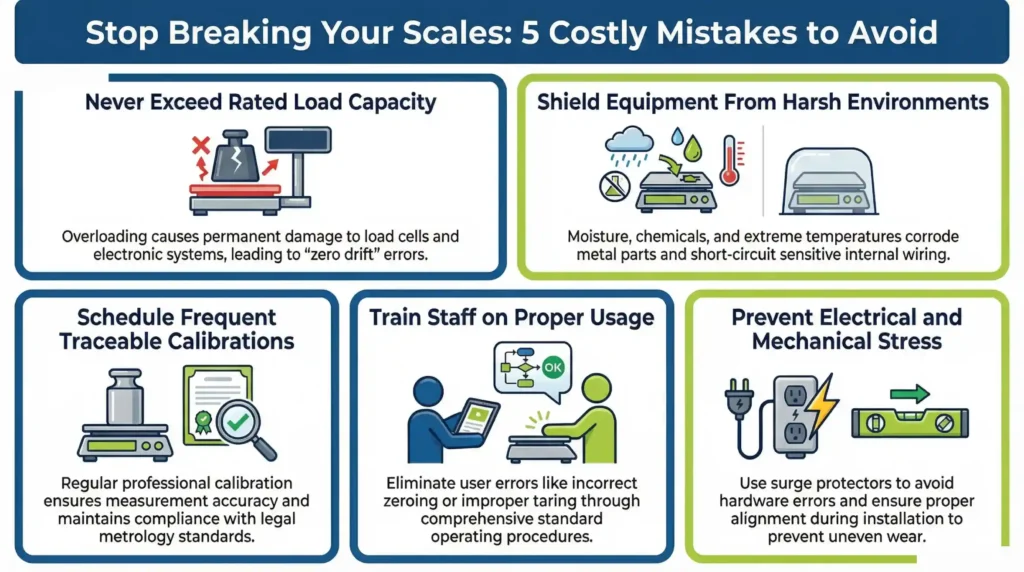
One of the most frequent mistakes that businesses make is overloading their industrial weighing scales. Whether you’re using hopper scales, tank scales, or platform scales, exceeding the load capacity of the scale can cause permanent damage to vital components, such as the load cells, strain gauges, and electronic systems.
- Impact on Load Cells: Load cells are designed to measure the weight of materials accurately. Overloading them can cause them to become misaligned or damaged, leading to inaccurate measurements and the need for expensive repairs.
- Internal Stress: Exceeding the weight capacity can also cause internal components to wear out prematurely. This results in miscalculations or zero drift (when the scale does not return to zero even after removing the load), making the scale unreliable for production or quality control.
Risks of Underusing Industrial Scales
While overloading is a major issue, underuse of scales can also cause problems. For example, high-capacity scales that are rarely used may fail to maintain accurate measurements over time. Scales that are not used regularly can experience problems such as:
- Dust accumulation or corrosion in certain components affects their performance.
- Signal drift due to the scale not being calibrated frequently enough.
How to Avoid Overloading and Underuse
- Know Your Scale’s Capacity: Always be aware of the maximum weight that your scale can handle, and make sure that you stay within those limits to avoid overloading.
- Monitor Load Usage: For scales that handle high volumes, such as hopper scales or tank scales, ensure that you distribute the weight evenly and do not exceed the scale’s design specifications.
- Use Scales Regularly: For scales that aren’t frequently used, establish a schedule to calibrate and test the scale at regular intervals, ensuring that it’s always ready when needed.
Mistake # 2: Exposure to Harsh Environmental Conditions
Industrial weighing scales, especially those used in manufacturing or outdoor environments, are often exposed to harsh moisture, corrosion, and chemical exposure. If your facility uses corrosive cleaning agents or experiences high humidity, the choice between mild steel vs stainless steel floor scales is the difference between a scale that lasts a decade and one that fails due to rust in six months. These environmental factors can lead to the degradation of critical scale components, affecting the scale’s accuracy and functionality.
- Moisture Damage: Moisture can cause corrosion in metal parts, particularly in load cells and electronic systems. Over time, this corrosion can short-circuit or damage internal wiring, leading to malfunctions and the need for costly repairs.
- Chemical Exposure: Certain chemicals, such as acids or solvents used in food production or manufacturing, can eat away at the scale’s components, causing damage to sensors, weighing pans, and even power systems.
The Impact of Temperature Extremes and Vibrations
In addition to moisture and chemicals, extreme temperatures (either too high or too low) and vibrations can also compromise the performance of industrial scales. For example:
- High Temperatures: Extreme heat can cause certain scale components, such as load cells or strain gauges, to expand or contract, affecting their accuracy and functionality.
- Vibrations: Vibrations from heavy machinery or high-traffic areas can interfere with signal stability, leading to inaccurate weight readings and unreliable performance.
How to Protect Scales from Environmental Damage
- Use Corrosion-Resistant Materials: Opt for scales made from stainless steel or corrosion-resistant materials, which can withstand exposure to moisture and chemicals.
- Install Protective Covers: Use protective covers to shield scales from moisture, dust, and chemicals in manufacturing environments.
- Temperature Control: For scales used in extreme temperatures, consider using temperature-controlled environments or heat-resistant scales.
- Vibration Dampening: Install vibration isolation pads under scales in environments with heavy machinery or high levels of physical movement.
Mistake # 3: Neglecting Regular Calibration and Maintenance
One of the most significant mistakes businesses make is neglecting the calibration and maintenance of their industrial scales. Calibration is crucial to ensure that scales provide accurate and reliable readings over time. Without regular calibration, scales can experience zero drift, causing them to provide incorrect measurements.
- Calibration and Compliance: Many industries require that scales be calibrated regularly to comply with legal metrology standards. Without this, businesses may risk failing regulatory inspections and facing penalties or fines.
- Maintaining Measurement Accuracy: Regular calibration ensures that your scale measures accurately and reliably, which is especially important for businesses involved in food production, pharmaceuticals, or chemical processing.
How to Avoid Neglecting Calibration and Maintenance
The most effective way to eliminate zero-drift is to move beyond DIY checks and implement a schedule for SANAS traceable scale calibrations, ensuring every gram is accounted for under legal metrology standards.
- Set a Regular Calibration Schedule: Create a routine for calibrating your scales based on usage frequency, ensuring that they remain compliant and accurate.
- Choose a Service Package: Work with a scale service provider, such as Scales4U, to provide routine maintenance and calibration services.
- Train Your Team: Ensure that your team is aware of the importance of scale maintenance and proper calibration procedures.
Mistake # 4: Electrical and Power Supply Issues
One of the most common yet often overlooked causes of weighing scale malfunction is battery failures and power surges. Industrial scales, particularly digital weighing systems, rely heavily on consistent power to function accurately. If the battery is low or the power supply is unstable, the scale can provide incorrect readings or stop working altogether.
Battery failure typically occurs when the scale has not been maintained properly, leading to depleted or faulty batteries that cannot power the system. If the scale is left uncharged for long periods, it can cause inaccurate readings and loss of data.
Power fluctuations are often the ‘invisible’ culprit behind hardware errors; understanding why digital scales give inconsistent readings, from low battery voltage to electromagnetic interference, can help you diagnose an issue before replacing expensive parts. A surge can occur when electrical power spikes or fluctuates unexpectedly, potentially damaging the scale’s internal electronics, particularly load cells and sensors that are sensitive to voltage variations. These electrical issues can lead to permanent damage or malfunctions, requiring expensive repairs.
Impact of Power Issues on Scale Accuracy
An unstable power supply can lead to signal drift, especially in scales that rely on load cells for accuracy. When the power fluctuates, the readings from the load cells may become inconsistent, even when the same weight is measured multiple times. For example, in food processing or pharmaceutical industries, where consistent measurements are critical, even the slightest variance can lead to compliance issues or product inconsistency.
Moreover, battery-powered scales may begin to lose calibration when battery levels dip too low, leading to inaccurate weight measurements. This can be particularly damaging in high-precision environments such as laboratories or medical settings where accurate measurements are essential.
Preventive Measures for Power Issues
To avoid battery failures and power surges, businesses should take the following steps:
- Install surge protectors and uninterruptible power supplies (UPS) to ensure that power surges do not affect the scale’s functionality. These devices act as a buffer, protecting your scale from power interruptions and surges.
- Regularly check and replace batteries to ensure that digital weighing systems maintain optimal performance. For battery-powered scales, consider using high-quality, long-lasting batteries and have backup batteries on hand to avoid downtime.
- Use a stable power source: Ensure that the power supply to your scale is consistent and reliable, especially for large industrial systems that may experience power fluctuations.
Mistake # 5: Mechanical Damage and Misalignment
Mechanical failures are another significant factor that can cause industrial weighing scales to malfunction. These issues arise due to misalignment, wear and tear, or improper handling of the scale components. In heavy-duty environments, such as manufacturing or logistics, scales are subjected to physical stresses that can lead to mechanical damage.
The most common mechanical issues arise from improper installation, where components like the weighing pan, load cells, and supporting structure are not aligned correctly. Misalignment can cause uneven weight distribution, resulting in inaccurate measurements and eventually damaging internal parts. Additionally, frequent use can cause certain parts of the scale to wear down, affecting the scale’s precision.
Signs of Mechanical Damage
Some of the signs of mechanical failure or misalignment include:
- Irregular readings: If your scale is showing inconsistent weight readings, even when the same item is weighed multiple times, this could be a sign that the scale is misaligned.
- Physical damage: Visible cracks, dents, or misalignment in the weighing pan or frame indicate that the scale has been subjected to improper handling or heavy use.
- Uneven operation: If the scale doesn’t seem to operate smoothly, or there’s resistance in moving parts, this could be a sign of internal mechanical issues, such as worn-out springs or damaged load cells.
Preventing Mechanical Failures
To prevent mechanical damage and misalignment:
- Ensure proper installation: Always follow the manufacturer’s instructions for installation, and hire a professional technician to ensure everything is aligned and calibrated correctly.
- Use durable materials: When selecting scales for heavy-duty operations, ensure that they are made of high-quality materials, such as stainless steel or aluminium, which can withstand heavy use and physical stress.
- Regular inspections: Schedule regular maintenance checks to ensure that all mechanical components, like weighing pans and load cells, are functioning correctly. This can prevent minor issues from turning into major problems.
Mistake # 6: Software and Connectivity Issues
The Role of Software in Scale Operation
As industrial scales become more advanced, they often rely on software for functionality. Scales with smart connectivity features, such as data logging, remote monitoring, and integration with POS systems, offer significant advantages. However, these digital features can also introduce new problems if not properly managed.
- Software glitches: Inaccurate data recording or system freezes can occur when the scale’s software encounters bugs or crashes, resulting in incorrect readings.
- Connectivity issues: Poor or interrupted Wi-Fi connections or Bluetooth failures can prevent the scale from syncing with the system or logging data properly, which can lead to delays and errors in production processes.
Common Software Glitches That Affect Scale Performance
Software glitches can manifest in several ways:
- Data loss: A malfunctioning software system can cause scales to fail in recording measurements, leading to a loss of important data and unreliable reporting.
- Syncing problems: For scales that require integration with inventory systems, software issues can prevent seamless data transfer, leading to discrepancies between measured weight and inventory levels.
- Unresponsive screens: When the scale’s digital display freezes or doesn’t respond to inputs, it may indicate that the software is malfunctioning.
Fixing Connectivity Issues and Software Problems
To prevent or fix software issues:
- Regular updates: Ensure that the scale’s software is up to date with the latest patches and bug fixes.
- Work with IT specialists: If you experience persistent software issues, consult an IT professional or the scale supplier for troubleshooting.
- Check connectivity: Ensure your scale’s connection to the network is stable. Use wired connections if Wi-Fi or Bluetooth connections are unreliable in your environment.
Mistake # 7: Poor Staff Training and Misuse
One of the most common, yet easily preventable, mistakes in maintaining industrial weighing scales is poor staff training. Inadequately trained staff can lead to numerous errors that affect the scale’s performance, longevity, and accuracy. For example, improper zeroing of the scale, incorrect use of the tare function, or failure to follow correct calibration procedures can all lead to inaccurate readings and unnecessary wear on the equipment.
Without proper training, staff might also mishandle scales, especially in high-traffic environments where they are frequently moved or interacted with. Poor handling practices, such as dropping the scale, overloading it beyond its capacity, or using it inappropriately in harsh conditions, can damage critical components, such as load cells or strain gauges.
Common User Mistakes That Damage Scales
Here are some common mistakes that can damage your industrial scales:
- Overloading Scales: Exceeding the load capacity of the scale is one of the most damaging errors. It places undue stress on the load cells, mechanical parts, and electronic systems, which can lead to long-term damage.
- Incorrect Zeroing: Failing to properly zero the scale before weighing can cause inaccurate measurements. This is particularly problematic in industries where precision is critical, such as laboratories and pharmaceuticals.
- Improper Calibration: Calibration should be done regularly to maintain accurate readings. Skipping this process can lead to discrepancies in weight measurement, which can affect product quality or compliance.
- Not Using the Tare Function Properly: The tare function is essential for subtracting the weight of containers or packaging materials. Misusing this function or forgetting to tare the scale can lead to incorrect readings.
- Neglecting Environmental Conditions: Not accounting for temperature extremes, vibrations, or moisture in the environment can also impact the scale’s performance. Staff must be trained to recognise and mitigate these factors.
Implementing Effective Training Programs
To prevent the above errors and ensure scales are used correctly, businesses should establish a comprehensive training program for their staff. Key elements of a successful training program include:
- Standard Operating Procedures (SOPs): Develop clear SOPs for scale operation, calibration, and maintenance. These documents should outline the proper handling of scales, how to zero and tare the scale, and how to detect common issues.
- Hands-On Training: Provide practical, hands-on training to ensure staff are familiar with the scale’s functions and features. Training should include how to use the tare function correctly, how to interpret weight readings, and how to maintain scale accuracy.
- Ongoing Education: Regular refresher courses or training updates are important to ensure staff stay informed on best practices and any new technologies or updates to the weighing system.
- Maintenance and Troubleshooting: Train staff not only on how to use scales but also on basic maintenance and troubleshooting steps. This includes cleaning, calibration checks, and identifying when the scale needs professional servicing.
By investing in proper training and ensuring that employees understand the critical role of accurate weighing, you can prevent many of the common mistakes that lead to damage and ensure your industrial weighing scales stay in top working condition.
Final Thought
By avoiding these 7 common mistakes, businesses can extend the lifespan of their industrial weighing systems, ensure accurate measurements, and prevent costly repairs. From overloading scales to neglecting regular maintenance, these mistakes can significantly affect your scale’s performance and accuracy.
At Scales4U, we offer calibration, maintenance and repair services for industrial weighing systems. Our expert team can help you ensure that your scales are running at their best, minimising downtime and maximising operational efficiency. If you need assistance with your scale maintenance or are experiencing any of the issues discussed in this guide, don’t hesitate to contact us today.